

When arranging certified legal document translation Nairobi, delays can start before the translator sees the documents. Missing pages, faint seals or names that differ across records can lead to avoidable follow-up requests. Preparing a complete source file is a practical first step.
It’s understandable to want confidence that a translation will meet the receiving institution’s requirements. Certification relates to the translation; authentication and other formalities may be separate steps, depending on the document and recipient. Knowing the difference helps you prepare without assuming that translation alone satisfies every submission requirement.
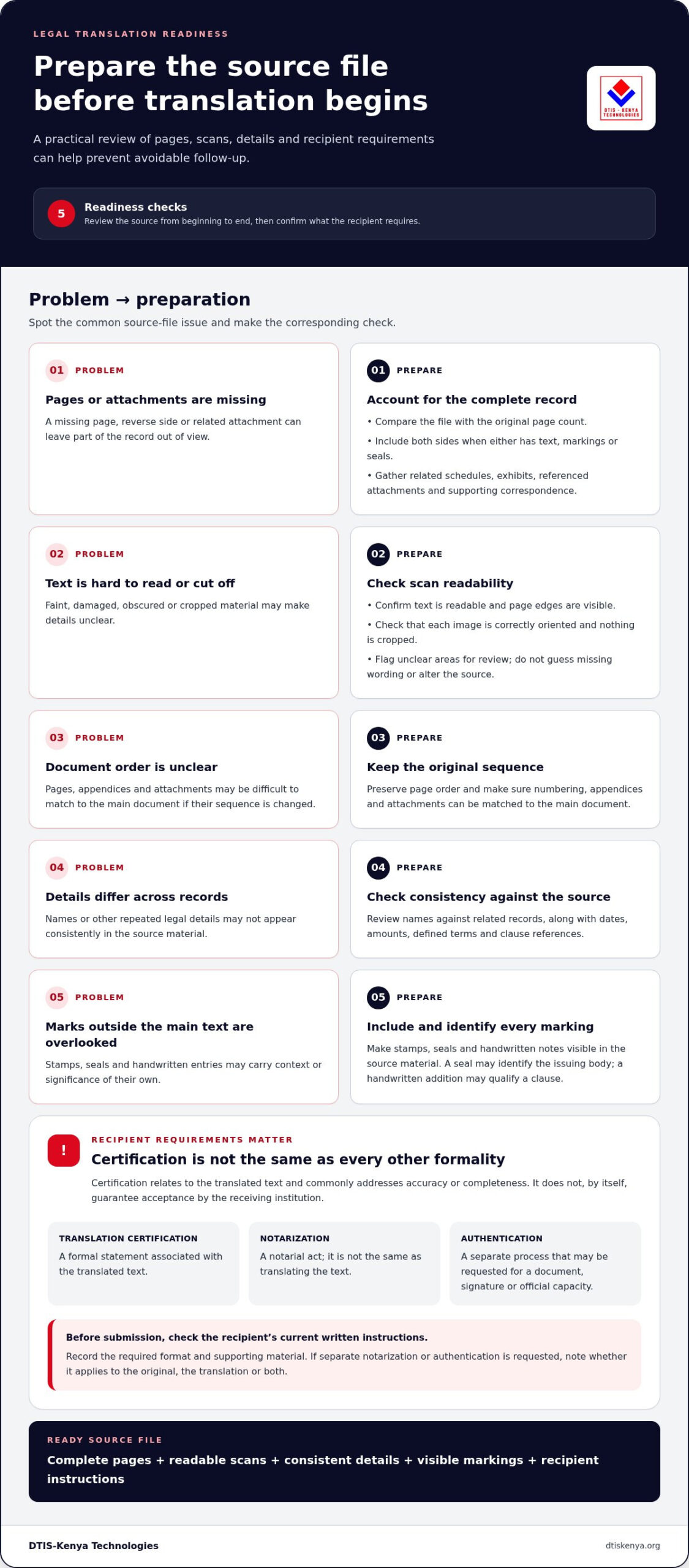
This checklist explains how to review each page, stamp, seal and attachment, improve scan readability, and check names and dates for consistency before translation begins. It also explains why recipient-specific instructions matter and what to clarify about certification and separate authentication. DTIS-Kenya Technologies provides document translation services, including certified translations. With a complete, legible source document and a clear understanding of the next steps, you can prepare your translated records more confidently and reduce preventable delays.
Key Takeaways
- Use a readiness checklist to review every page, attachment, stamp, seal and handwritten note before sending legal records for translation.
- Check names, dates, amounts, defined terms and clause references against the source document to help preserve consistency.
- Understand what certification covers and why a translated legal document may still need to meet the receiving institution’s requirements.
- Record the recipient’s current instructions and distinguish translation format requirements from any separately requested authentication or notarization.
- Prepare the document’s purpose, readable source material and recipient instructions to support an orderly translation process with DTIS-Kenya Technologies.
What Certified Legal Document Translation Means, and What It Does Not
A certified legal document translation is a translation accompanied by a formal statement or other indication that the translated text accurately represents the source document. The form of certification can vary, so the term alone does not establish what a particular recipient will accept. Certification relates to the translation and its preparation; it is not automatic approval for every legal or administrative purpose.
Ordinary translation conveys the meaning of text in another language. A certified translation adds a formal element that identifies the translation as an accountable, complete rendering of the source. For a foundational overview of the concept and how requirements vary across jurisdictions, see What is a Certified Translation? The receiving institution’s written instructions are the practical guide. They may specify the required format, supporting material or additional steps.
Certified translation means a translated document is formally accompanied by a statement of its accuracy; it does not, by itself, guarantee acceptance by the receiving institution. This distinction sets clear expectations when arranging certified legal document translation. A carefully prepared translation can support a submission, while the recipient determines whether it meets its requirements.
Which legal and official documents commonly require translation?
Documents that may need translation include contracts, court records, certificates and supporting legal correspondence. A contract may contain defined terms and cross-references; a court record may include handwritten notes or seals; a certificate may have annotations that need to be rendered alongside its main text. The document category alone does not determine whether translation is needed or what format is acceptable. Review the receiving institution’s current written instructions for the applicable document list and submission details.
Certification, notarization, and authentication are different steps
These terms describe distinct functions. The exact process depends on the destination and the recipient’s instructions:
- Translation certification is a formal statement associated with the translated text, commonly addressing its accuracy or completeness.
- Notarization generally involves a notarial act, such as witnessing a signature or authenticating a document-related declaration. It is not the same as translating the text.
- Authentication is a separate process used to verify a document, signature or official capacity for a specified purpose. Legalization may also be requested in some cross-border processes, but its meaning and steps depend on the relevant jurisdiction.
A recipient may request a certified translation and separately require notarization or authentication of the original document or another supporting record. Do not assume these requirements apply universally. Find the recipient’s instructions and note exactly what they apply to: the original, the translation or both. For any specific legal procedure or destination-country requirement, rely on current authoritative guidance before taking action.
Prepare Your Source Document: A Legal Translation Readiness Checklist
A careful review of the source file gives the translation process a reliable starting point. Missing pages, unreadable text or overlooked notes can obscure meaning. Keeping the document as issued helps the translation stay aligned with the original. Use this checklist before submitting legal records for translation.
Check completeness, legibility, and document order
Review the file from beginning to end, including pages that may seem secondary. A reverse side can contain a stamp, and a schedule or attachment may carry terms that qualify the main document. Practical legal translation guidance, including Best Practices for Legal Translation Accuracy, also emphasizes careful source review before work begins.
- Account for every page. Compare the page count with the original and include both sides of a page when either contains text, markings or seals.
- Include related material. Gather schedules, referenced attachments, exhibits and supporting correspondence that form part of the record or are requested by the recipient.
- Check scan quality. Confirm that text is readable, page edges are visible, each image is correctly oriented and no words or details have been cropped.
- Keep the original sequence. Preserve page order and make sure numbering, appendices and attachments can be matched to the main document.
- Flag unclear areas. If text is faint, damaged or obscured, identify its location for review. Do not guess at missing wording or alter the source to make it appear clearer.
Identify names, dates, stamps, and handwritten entries
Details outside the main printed text may carry legal or administrative significance. A seal can identify the issuing body, a handwritten addition may qualify a clause, and a reference number can link one record to another. Include these elements in the source material so they can be considered in context.
- Compare personal names with related records and note differences in spelling or order. Preserve each version as it appears rather than silently standardizing it.
- Keep dates, case or file references, amounts and page numbers exactly as shown.
- Make signatures, stamps, seals, handwritten notes and marginalia visible in the scan, even when they are difficult to read.
- Do not edit, overwrite or mark the original to make inconsistent details match. Flag discrepancies separately for review.
Completeness and legibility are the foundation of document readiness: account for every relevant page and make each detail readable before translation begins. An ordered source file makes it easier to identify gaps early and reduces avoidable clarification during the process. A careful review supports an orderly handover, while the receiving institution’s instructions determine its specific requirements. When your source material is ready, DTIS-Kenya’s certified document translation service can support the next step.
Review Legal Terminology, Names, and Formatting Before Submission
After confirming that the source document is complete and readable, review the translation against it for details that carry meaning across pages. Legal language does not always map word for word between languages. The goal is to preserve meaning and context while keeping defined phrases, references and figures consistent throughout the document.
| Source detail | Translation check | Reason it matters |
|---|---|---|
| Personal and organizational names | Compare spelling and word order with the source, character by character. | Consistent names help identify the same people or entities across records. |
| Dates and amounts | Check every date, figure, currency reference and number against the original. | A changed digit or date format can create uncertainty about a key fact. |
| Defined terms | Confirm that a term introduced with a specific meaning is used consistently later. | Shifting terminology can blur the connection between a definition and its later use. |
| Clause and case references | Match clause numbers, case references and cross-references to the source. | Accurate references help readers locate the relevant provision or record. |
| Repeated legal phrases | Review recurring phrases for consistent meaning, while respecting context. | Consistent treatment helps preserve the document’s internal logic. |
How to check names, dates, and internal references
Work through names and identifiers systematically rather than relying on a general reread. Compare personal and organizational names against the source, checking spelling and order character by character. Then verify dates, numbered clauses, case references and cross-references wherever they appear. If a source name is spelled differently in a related record, record the discrepancy instead of choosing one version. Separate apparent source errors from translation issues, and do not silently correct either.
Consistent names and references make a legal document easier to trace across pages and related records. This matters when a contract cites an attachment, a judgment refers to a case number, or the same party appears in several sections. A structured review can make discrepancies visible before the document is submitted.
How formatting supports a reliable document review
Compare headings, paragraph breaks, tables, signatures, seals and page sequence with the source. Similar visual structure helps readers move between documents, but it does not establish legal validity or recipient acceptance. If a phrase is unclear or a reference appears inconsistent, note the page and passage in a query list. This gives the translator a precise point to review without filling gaps with invented wording.
- Identify the page and paragraph for each query.
- Quote the unclear source wording where it can be read.
- Describe the uncertainty without proposing an unsupported correction.
- Keep notes separate from the source document and translated text.
After the review, check that terminology, names and references remain consistent from the first page to the last. Clear queries preserve uncertainty for resolution rather than concealing it.
Check the Receiving Institution’s Requirements Before Using the Translation
A carefully prepared translation is only one part of a submission. The receiving institution sets the requirements for the documents it reviews, and these can differ by recipient or purpose. Before arranging final copies or additional formalities, record the institution’s current written instructions. This helps distinguish translation specifications from separate document checks.
Record the recipient’s exact document and format instructions
Use the receiving institution’s official guidance for the specific application or proceeding. Do not rely on an old checklist or instructions intended for a different submission. If the guidance is unclear or conflicting, seek clarification from the institution and keep a written record of the response.
- Locate the current instructions. Find the guidance issued for the particular document and purpose, then note when you accessed it.
- Record the language and format. Capture any stated requirements for the translation’s language, layout, certification details or accompanying components.
- Note what must be submitted. Check whether instructions refer to originals, copies, scans or supporting documents, and whether they specify how these should be presented.
- Resolve uncertainty before submission. If a requirement is ambiguous, ask the receiving institution what it applies to and retain that clarification with your records.
Keep the wording precise. For example, a direction to provide a translated copy should not be treated as a requirement for an original unless the institution says so. Requirements can vary, so do not assume a format accepted by one recipient will apply to another.
Treat authentication and submission steps as separate checks
Translation certification and document authentication address different matters. A certified translation does not automatically complete every separate step a recipient may request. Instructions might refer to notarization or an apostille, for example, but whether either applies depends on the recipient, the document and the relevant jurisdiction. Do not assume that one route is mandatory for every submission.
Make two distinct entries in your preparation notes: one for translation requirements and another for any formalities requested for the source document or accompanying records. For each item, capture the exact wording and identify which document it concerns. If a requirement names an authority, procedure or legal standard, verify it using current authoritative guidance before relying on it. Rules may differ across jurisdictions and can change. Broad claims about a universal process can lead to unnecessary steps or leave a requested one incomplete.
- Does the instruction concern the translation, the original document, or both?
- Does it name a specific form of notarization, authentication or legalization?
- Is the direction current and applicable to this exact submission?
These checks help you prepare certified legal document translation for its intended use without treating translation as a guarantee of acceptance. Once you have the recipient’s instructions and readable source material ready, arrange certified document translation with DTIS-Kenya.
Arrange Certified Legal Document Translation with DTIS-Kenya
Once your source records are assembled and the receiving institution’s instructions are at hand, prepare a clear translation request. DTIS-Kenya Technologies provides certified document translation, including for legal records. An organized handover helps establish the document’s purpose, identify the material to translate and bring recipient-specific requirements into view from the outset. It does not replace the institution’s submission rules or guarantee acceptance.
What to prepare when arranging a certified translation
Bring together the materials and notes from your readiness review. The aim is to provide a coherent source file and enough context to handle terms and references carefully, without making assumptions about unclear details.
- Identify the document’s purpose. Briefly explain what the legal record is and how it will be used, such as for a contract review, a court-related matter or an administrative submission. Context helps clarify the nature of the text without changing its meaning.
- Provide the complete source material. Include every relevant page, reverse side, schedule and attachment in readable form, keeping the original order. If a scan contains faint or unclear passages, point them out rather than filling in the wording yourself.
- Share the recipient’s published instructions. Provide the current written guidance you have found, including any specifications for the translation or accompanying documents. This helps distinguish translation needs from separate submission steps.
- List items requiring attention. Note name-spelling differences, unusual terms, inconsistent references and source passages that may need review. Keep questions specific, with the page or section identified where possible.
This preparation makes the request easier to understand and keeps important context with the source documents. It also gives you a useful record of what was supplied and which recipient instructions informed the request. For organizations coordinating terminology, reviewers and delivery across multilingual projects, see this guide to translation services for international organizations in Kenya.
A structured next step with DTIS-Kenya
DTIS-Kenya Technologies provides certified document translation services in Kenya. For legal material, attention to terminology, names, dates and document structure helps maintain a clear relationship between the source and translated text. The receiving institution remains responsible for its own requirements and decision on acceptance.
The company’s work also creates employment opportunities for women, youth and refugees, connecting language services with broader participation in the economy. For individuals and organizations preparing legal records, a complete source file and concise instruction set can support an orderly process and reduce avoidable back-and-forth about missing context.
When your checklist is ready, discuss a certified document translation request with DTIS-Kenya. Provide the document’s purpose, readable source material and recipient instructions as the basis for the request.
Take the Next Step Toward a Prepared Submission
Keep the recipient’s written instructions with the final translation materials, and use that guidance as you prepare your submission. If the recipient updates its directions, record the change before submitting so you are relying on the current requirements. This simple administrative habit helps keep the translation and submission process connected without assuming that certification alone determines acceptance.
For individuals and organizations arranging certified legal document translation Nairobi, a well-defined request is a practical place to begin. Share the document’s purpose and the receiving institution’s instructions with DTIS-Kenya to give the translation work relevant context. The receiving institution remains responsible for its requirements, while a carefully coordinated language-service process can help you move forward with clarity.
Start a certified translation request with DTIS-Kenya. Share your document’s purpose, readable source material and recipient instructions to get started.
Frequently Asked Questions
Can handwritten notes on a legal document be translated?
Yes. Handwritten entries can affect how a record is understood, so include them rather than submitting only the typed text. Provide a clear image of the whole page and, if useful, a closer view of the handwriting while retaining its position on the page. Identify entries that are hard to read. If the wording remains unclear, flag it for review instead of guessing or silently rewriting it.
Should stamps and seals on a legal document be translated?
Include visible stamps and seals in the source material. They may show a name, date, office, reference number or other information that helps explain the record. The receiving institution’s instructions determine how these details should appear in the translation, so keep them visible and note any specific direction. A stamp or seal on a document does not, by itself, establish that the document has been authenticated or will be accepted.
Can I submit a scan instead of the original document for translation?
A clear scan can be used to prepare material for translation, but that does not establish what the receiving institution will accept at submission. Check whether its instructions call for a digital file, copy or original before relying on a scan. Inspect the image at normal reading size, including small print and page edges. Keep the original safely available in case the recipient’s process later requires it.
What should I do if my name is spelled differently across legal documents?
Keep each source document unchanged and make a note of the different spellings. Provide the related records together so the translation can reflect the name as it appears in each one, rather than hiding the difference through an assumed correction. For example, point out a missing middle name or a variation in surname spelling. The receiving institution determines how to handle the discrepancy in its process.
Do blank fields or unused sections need to appear in a legal translation?
Follow the receiving institution’s format instructions, since they may determine whether blank fields or unused sections should be reproduced. Retaining labels and empty spaces can help readers compare a translated form with its source, but adding text that is not present could misrepresent the record. Give the translator the complete form and distinguish a genuinely blank field from one that is obscured or unreadable, so the difference is clear.
Can a certified translation be submitted electronically?
That depends on the receiving institution’s current submission rules. Before uploading or emailing a translation, check the permitted file type, how the certification must appear, and whether the recipient requires printed supporting documents or another delivery method. Keep a copy of the exact version submitted, along with the source file and submission instructions. This record can help identify which document version was provided if a follow-up is needed.
Does a certified translation expire?
There is not necessarily one expiry rule that applies to every translation. A recipient may set a time limit or require a source record issued within a particular period, which is different from a rule about when the translation itself was prepared. Check the current written instructions for both dates. If the guidance refers only to the age of the original document, do not assume it also sets an expiry date for the translation.
Document Translation Services In Kenya: How To Choose The Right Support
21/10/2026 12:00 pm[…] Before arranging a translation, read the recipient’s published instructions for certification, document presentation and any additional steps. Use those requirements to shape the brief, especially if they specify a format or process. DTIS-Kenya Technologies provides certified document translation as part of its document translation services Kenya, with the document’s intended use made clear in the project instructions. For a detailed preparation checklist, see the practical guide to certified legal document translation in Kenya. […]