

Could a correctly translated document still be unsuitable for the purpose you need it to serve? Choosing among document translation services Kenya offers starts with understanding who will use the document and what they require. A certificate for an official process, for example, may call for a different approach from a business report prepared for multilingual readers.
Certification, names, formatting and other official details can all affect a translation request. The right service depends on the document’s purpose, while a clear brief and legible source files help communicate the details that matter. This guide explains how to identify the translation support your document needs, prepare useful instructions, and distinguish document translation from related services such as transcription and content localization.
DTIS-Kenya Technologies provides document translation, including certified document translation, alongside interpretation, transcription and localization for related multilingual needs. Founded in 2009, the organisation also creates employment opportunities for women, youth and refugees. This guide covers how to choose an appropriate service for your document and how DTIS-Kenya can support a clearly scoped project.
Key Takeaways
- Start with the document’s purpose and recipient requirements to determine which translation option is appropriate.
- Understand how document translation, certified translation, transcription and localization differ in their inputs, outputs and uses.
- Prepare complete, readable files and clear instructions to reduce avoidable questions about names, missing pages or formatting.
- Identify how document translation services Kenya can support administrative, educational, business and personal document needs.
- See how DTIS-Kenya brings document translation together with related multilingual services for projects with broader communication needs.
What document translation services in Kenya cover, and when you may need them
Document translation transfers written information from one language into another while preserving its meaning, details and intended purpose. That means carrying across more than individual words. Names, dates, figures, terminology and the way sections relate to one another all contribute to what a document communicates. For a foundation in the field of translation, consider how meaning is conveyed across languages and contexts.
Individuals and organisations may need translations for administrative submissions, education, business communication or personal records. The right service depends on how the translated document will be used, not just its title. A report for internal review, for example, may have different requirements from a document being submitted to an institution. If formal presentation is required, follow the recipient’s published instructions before preparing the translation.
Document translation also differs from two related language services. Interpretation conveys spoken communication between languages, often during a meeting or appointment. Transcription turns recorded speech into written text; by itself, it does not translate that text into another language. Knowing the difference helps you request work that matches both the material you have and the outcome you need.
Which documents commonly need translation?
Start with the document’s purpose and intended reader. These examples illustrate common needs, but the document category alone does not determine whether certification is necessary:
- Personal records: Certificates and other records prepared for personal or family use.
- Educational documents: Academic documents and reports used for study-related communication or submissions.
- Administrative documents: Certificates and records prepared for an administrative process.
- Organisational documents: Contracts, financial records and reports used in business communication or internal operations.
A document may serve more than one purpose. A report might be for internal review or a formal submission; a contract might be shared with a multilingual business partner. Naming the reader and intended use helps define the project scope and the instructions the translator needs.
What does certified document translation mean?
Certified document translation is a translation presented with a formal statement about its status. The format and supporting requirements can depend on the institution receiving the document, so the term alone does not establish that every recipient will accept it.
Before arranging a translation, read the recipient’s published instructions for certification, document presentation and any additional steps. Use those requirements to shape the brief, especially if they specify a format or process. DTIS-Kenya Technologies provides certified document translation as part of its document translation services Kenya, with the document’s intended use made clear in the project instructions. For a detailed preparation checklist, see the practical guide to certified legal document translation in Kenya.
How document translation works, from source file to completed translation
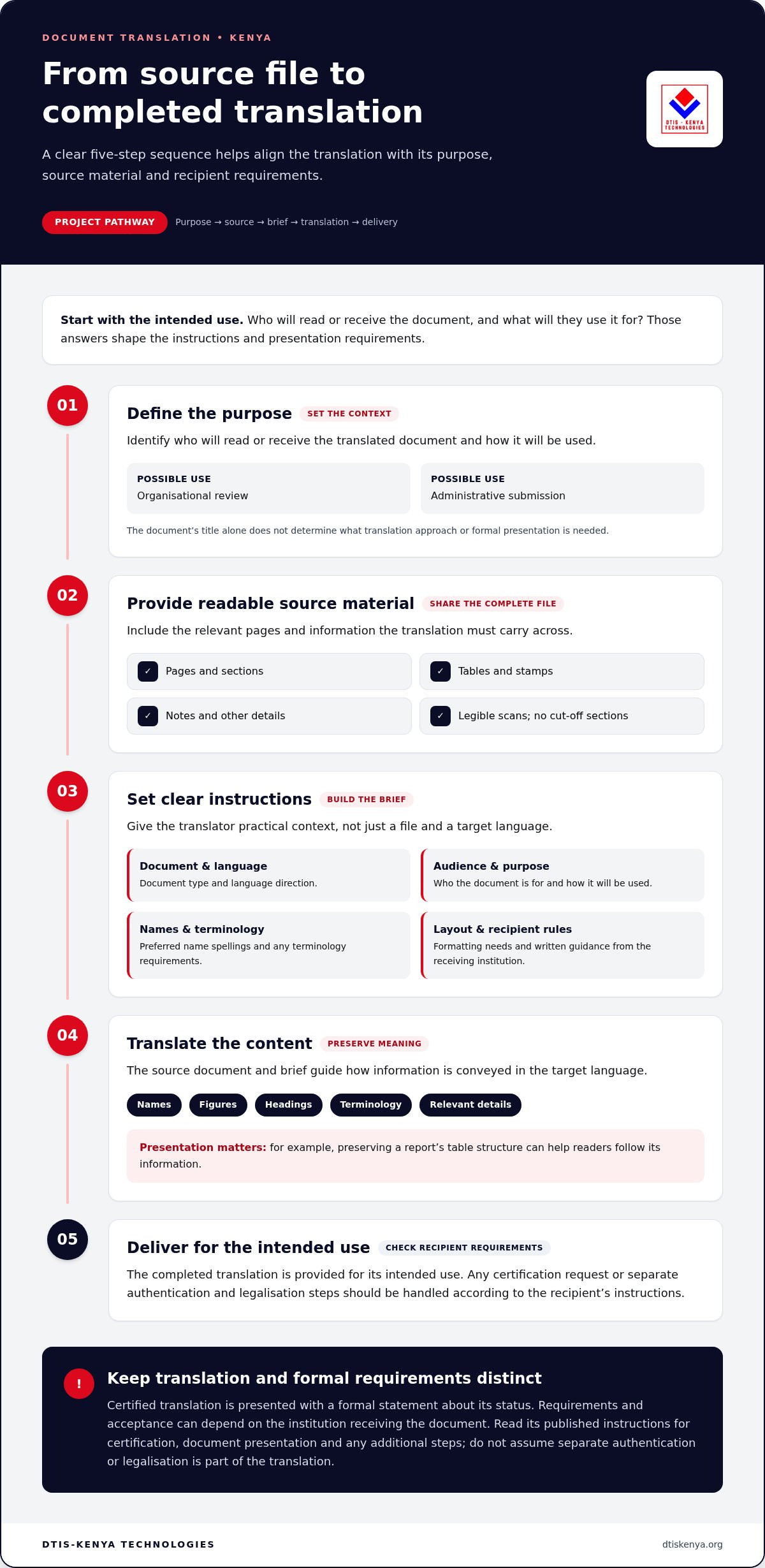
A well-organised translation project begins before any wording is translated. The document’s purpose, source material and recipient’s instructions shape the brief and help the translation reflect the right meaning and presentation. A clear sequence also helps distinguish the translation itself from any additional formal steps that may apply.
- Define the purpose. Identify who will read or receive the translated document and how it will be used, such as for an organisational review or an administrative submission.
- Provide readable source material. Share the complete document, including relevant pages, tables, stamps or notes. Check that scans are legible and no sections are cut off.
- Set instructions. State the document type, language direction, audience, preferred spelling of names, and any terminology or layout requirements. Include the recipient’s written guidance if it specifies a format.
- Translate the content. The source document and brief guide how the information is conveyed in the target language, including names, figures, headings and other details that affect meaning.
- Deliver the translated document. The completed work is provided for its intended use. Treat any certification request or separate authentication and legalisation steps according to the recipient’s instructions, rather than assuming they are part of the translation.
Document type, language direction, formatting and intended use all shape the project brief. A contract may need consistent treatment of defined terms, while a report with tables may need its structure preserved so readers can follow the information. State which details matter and how the translated material should be presented.
What information belongs in a translation brief?
A useful brief gives the translator practical context, not just a file and a target language. Identify the document type, intended audience and purpose, then specify the language direction. Add preferred spellings of names, layout or terminology instructions, and the receiving institution’s written requirements if they affect the requested format. If a name appears differently across records, explain which spelling to follow.
Before sending files, compare them with your instructions. This review can reveal a missing page, an unclear scan or a mismatch between a name on the document and the spelling requested in the brief. Resolving these details early can reduce avoidable questions during the project.
Why certification and acceptance requirements need context
Certification expectations are set by the organisation receiving the translation, and requirements can differ between institutions and uses. Review the recipient’s current published guidance, including directions about the form of certification or additional document steps. Do not assume a certified translation will meet every institution’s requirements simply because it is certified.
Translation certification is distinct from separate legalisation steps, which are not automatically included in a translation service. Keeping these processes separate makes it easier to identify what the translation request covers and what the recipient’s instructions require beyond it. DTIS-Kenya’s document translation support can be part of a project briefed around those requirements.
Which document translation service fits your project?
Match the material you have to the result you need. Written documents that need to be rendered in another language call for document translation; a formal submission may also require certified document translation, depending on the receiving organisation’s instructions. Recorded speech and audience-specific digital content call for different approaches. Use the comparison below to identify a suitable starting point.
| Service | Input | Output | Typical purpose |
|---|---|---|---|
| Document translation | Written material in a source language | Written content in another language | Sharing reports, records or business documents with readers of another language |
| Certified document translation | A written document and the recipient’s stated requirements | A translation presented with certification | Preparing a translated document for a process that requests certification |
| Transcription | Recorded speech | Written text of the speech | Creating a text record from an interview, meeting or other recording |
| Content localization | Digital content intended for a particular audience or market | Content adapted for that audience and market | Preparing digital material for people in a different linguistic or cultural context |
Interpretation is distinct from all four services. It conveys spoken communication between languages in real time, such as during a meeting. An organisation planning a multilingual project may combine services: it might translate written materials, transcribe recorded discussions and localize digital content for its audience. Choose the combination according to the project materials and communication goals. For organizations coordinating reviewers, terminology and delivery across teams, see this guide to translation services for international organizations in Kenya.
Document translation or certified document translation?
The key distinction is the document’s intended use and what its recipient requests. A translated report for internal reference may need document translation, while a submission may require certification if the receiving organisation says so. A document’s legal, academic or administrative category alone does not establish that certification is necessary, and certification alone does not guarantee acceptance. Use the recipient’s current instructions, and consult the separate certification checklist for detailed legal-document preparation.
When comparing document translation services Kenya offers, use a purpose-first approach: identify the recipient, intended use and any stated certification requirement before arranging the work.
When transcription or localization is the better fit
If the source is an audio or video recording and the desired result is written speech, transcription is the relevant service. If you already have digital content but need it adapted for a target audience and market, localization is a closer fit than translating the words alone. Describe the end use clearly so the project instructions match the material and desired outcome.
For more detail, consult the dedicated transcription and localization guides alongside this comparison. This distinction can also help organisations plan related language needs in one coordinated project, with each service assigned to the material it is designed to address.
How to prepare documents for accurate translation in Kenya
Careful preparation gives the translator a dependable source and makes the intended use clear. Before arranging a translation, review the receiving organisation’s current instructions. Requirements can differ, particularly when a translation is being submitted to an embassy or another institution, so rely on the recipient’s guidance rather than assumptions.
Check source documents before submission
Gather the complete version of each document and check every page before sending it. Confirm that text, stamps, tables and handwritten annotations are visible. Compare names, dates and document versions with the records you intend to submit. If a section is blurred, cut off or difficult to read, flag it rather than guessing at the missing content. This gives the translator a clear basis for the work.
Small gaps can lead to avoidable questions. A missing page may contain a note needed to understand the document; an unclear scan can make a date or name uncertain. Inconsistent spellings across a person’s records may also need an instruction, rather than an unspoken assumption about which version is correct. Retain the original spelling of names unless the recipient’s instructions or your brief specify otherwise. If a particular spelling must be used, provide a relevant reference document where appropriate.
Set clear expectations in the project brief
Explain the document’s intended use and audience, the language direction, and any instructions from the receiving organisation. Include preferred spellings for names, relevant terminology and layout requirements. If an embassy or institution provides written translation guidance, share the applicable instructions with the source files so the requested work can be scoped around them.
Be specific about what should remain consistent. If a report uses an organisation’s established terminology, provide a glossary or an earlier reference document. If the translated version needs to follow a particular layout, describe the requirement and identify sections where structure matters. Clear direction helps prevent unnecessary interpretation of names, terms and presentation preferences.
Use this checklist before submitting a request:
- Confirm the recipient’s current instructions, including any certification or presentation requirements.
- Gather the complete source document and check that each page is included.
- Review the legibility of text, stamps, tables and handwritten notes.
- Compare names, dates and versions, and flag any inconsistency or unclear text.
- State the purpose, audience and language direction in the brief.
- Provide spelling preferences, terminology references and layout instructions.
These steps do not replace recipient-specific requirements, but they help make the request clearer from the outset. The document translation request page is a starting point for sharing source files and instructions. For additional guidance on checking pages, seals, names and separate authentication requirements, consult this certified legal document translation checklist.
How DTIS-Kenya supports document translation projects
DTIS-Kenya Technologies provides document translation and certified document translation nationally in Kenya, supporting individuals and organisations with written material for different readers and purposes. Founded in 2009, the organisation also provides transcription, interpretation and content localization. These related services can support wider multilingual needs while remaining distinct from document translation.
For people seeking document translation services Kenya, the central considerations are the document’s purpose and the recipient’s instructions. A clear project brief helps establish whether the request calls for standard translation or certified document translation, and whether other language support is relevant. Certification is a service option, not a guarantee that a receiving institution will accept a document; its current requirements should guide the request.
A coordinated approach to multilingual document needs
Each service has a distinct role. Document translation transfers written content into another language. If the source material is a recording and the required result is written speech, transcription may be appropriate. Interpretation supports spoken communication, while localization adapts content for a particular audience and market. When a project includes more than one need, separating the tasks in the brief clarifies the intended output for each.
For example, an organisation preparing materials for readers in another language may need written documents translated and digital content localized for its audience. If a recorded discussion also needs to be converted into text, transcription addresses that separate requirement. Choose the combination according to the project’s materials and goals, rather than adding services without a defined purpose. Recipient instructions remain important when a translated document is being prepared for formal use.
Take the next step with a clear project brief
To define the appropriate service and scope, prepare a brief that identifies the document type, purpose, intended audience and language direction. Include the recipient’s relevant written instructions, particularly where they specify certification or presentation requirements. Preferred spellings for names, terminology references and layout preferences can also make the request more precise. The source files and their legibility provide useful context for the project.
DTIS-Kenya Technologies also creates employment opportunities for women, youth and refugees, connecting its language-service work with a practical commitment to economic participation. A well-defined brief gives a document translation or related multilingual project a clear starting point.
Review DTIS-Kenya’s document translation support for information relevant to your project.
Give your translation project a clear starting point
A translated document is part of a larger process: it helps information reach the person or institution that needs to act on it. Before moving forward, identify the recipient’s requirements and the outcome you need. That clarity helps you approach document translation services Kenya with a focused brief and a better understanding of which support fits.
DTIS-Kenya Technologies brings language services together with a commitment to creating employment opportunities for women, youth and refugees. The document’s purpose, language direction and any relevant instructions are useful starting points for defining the project.
Discuss your document translation needs with DTIS-Kenya and share the purpose, language direction and relevant instructions for your project.
Frequently Asked Questions
What is the difference between document translation and certified document translation?
Document translation provides written content in another language; certified document translation adds a formal statement about the translation’s status. The distinction matters if a recipient requests certification as part of its submission process. A document translated for internal reference may have different presentation needs from one submitted to an institution. When comparing document translation services Kenya offers, use the recipient’s instructions to identify which option fits.
Does a certified translation automatically meet every institution’s requirements?
No. A certified translation does not automatically satisfy every institution’s rules, since recipients may set different requirements for format or additional steps. Read the current instructions for the specific application or submission, rather than relying on requirements used for a different purpose. If the instructions specify a particular version or presentation, include that guidance in the translation brief.
Can I submit a scanned copy of a document for translation?
A clear scan can often provide source material for a translation, provided all relevant content is visible. Check that the full page, including stamps, tables, signatures and handwritten notes, can be read without obstruction. A cropped edge or blurred figure may make a detail uncertain. Keep the original available, too, since the organisation receiving the translated document may have separate instructions about what must accompany a submission.
How long does document translation take in Kenya?
There is no single timeframe that applies to every translation project. The document’s length, subject matter, language direction, source-file condition and requested certification can affect the work involved. A short, clearly typed letter has a different scope from a multi-page report with tables and specialised terminology. Sharing the complete files and intended use helps clarify the requirements that affect timing.
How much do document translation services cost in Kenya?
Cost depends on the project rather than a single rate that suits every document. Factors may include the amount of text, language direction, subject matter, file condition, formatting needs and whether certified document translation is requested. The complete document, its purpose and any recipient instructions help define the scope before pricing is discussed. A general estimate may not reflect the work a particular document requires.
Do I need to provide the original document for translation?
A readable copy can serve as source material for translation; whether you must present an original is a separate question determined by the recipient’s instructions. An organisation may accept a translated file for review but require original records or other supporting documents during submission. Keep the source document available and check the requirements for the specific process. Do not send an irreplaceable original unless the recipient’s instructions call for it.
Can document translation be combined with transcription or localization?
Yes, these services can support separate parts of a multilingual project. Transcription turns recorded speech into text, while localization adapts content for a particular audience and market. An organisation might need meeting audio transcribed, a written report translated, and digital content localized for its readers. Describe each source item and desired output separately in the brief so the scope reflects the distinct work required.