

What if the main risk in a multilingual project isn’t the translation itself, but the handoffs between teams? A report may be translated on schedule, yet inconsistent terminology, unclear approvals, or a late review can still delay its release. A dependable approach to translation services for international organizations Kenya teams need treats terminology, review, and delivery as one coordinated workflow.
Managing this work can feel demanding: departments may have different reviewers, recurring documents need consistent language, and administrative deadlines leave little room for confusion. Clear briefs and assigned responsibilities make projects more predictable and help keep materials aligned across languages.
This guide explains how to plan, coordinate, review, and deliver translation projects across Kenya, including how to maintain shared terminology and choose services suited to institutional needs. DTIS-Kenya Technologies provides document translation, content localization, interpretation, and transcription to support different organizational deliverables. Its work also creates employment opportunities for women, youth, and refugees, connecting language support with broader community inclusion.
Key Takeaways
- Bring reports, correspondence, and public-facing materials into a managed workflow to reduce terminology inconsistencies and unclear review handoffs.
- Use a clear sequence for preparing files, briefing, translating, reviewing, and approving materials, supported by existing glossaries and reference documents.
- Match each deliverable to the right service: document translation for written materials, certified translation for formal documents, and other language services for broader communication needs.
- For translation services for international organizations Kenya teams can use, prepare a concise brief covering audiences, language needs, deadlines, deliverables, and approval responsibilities.
- DTIS-Kenya Technologies’ translation and related language services support institutional communication while contributing to employment opportunities for women, youth, and refugees.
Why International Organizations in Kenya Need a Managed Translation Workflow
Reports, correspondence, presentations, and public-facing materials need to communicate clearly across languages, audiences, and teams. For international organizations working in Kenya, translation can support communication with programme participants, institutional partners, staff, and the public. The United Nations presence in Kenya reflects the country’s role in international work, where clear multilingual communication supports coordination across organizational activities.
A single document request may have a defined source file, recipient, and deadline. Recurring programme and administrative work is more complex: terminology needs to remain consistent across reports and updates, several departments may review a draft, and approval responsibilities can be unclear. If reviewers suggest conflicting terms or no one has authority to resolve them, revisions can multiply and delay communication. A managed workflow gives each stage and decision-maker a clear role.
Institutional translation coordination is the planned process of briefing, translating, reviewing, and approving multilingual materials so they remain clear and consistent across an organization.
Which organizational materials commonly require translation?
Translation needs depend on what an organization communicates and who needs to understand it. Common materials include programme reports, presentations, research summaries, policies, internal guidance, correspondence, and stakeholder communications. A public information document may need accessible wording for a broad audience, while a policy or research report may require close attention to defined concepts and specialist terminology.
Describe the document’s purpose, intended readers, and context in the brief, along with the preferred tone and any terms, names, or phrases that must remain consistent. Not every document needs the same review process, and certification is not automatically necessary. The document’s intended use and the receiving institution’s requirements help determine whether standard document translation or certified translation is appropriate.
What makes institutional translation different from a single document request?
Institutional work often involves a group of related materials rather than an isolated file. A programme might produce a policy, presentation, report, and stakeholder update that all refer to the same activities and concepts. If teams translate these separately without shared references, wording can vary and make the organization’s communication feel fragmented. Existing glossaries, approved terminology, and earlier translations help preserve continuity.
Review also needs clear ownership. A subject-matter specialist can check factual accuracy, while a designated communications or programme lead consolidates feedback and gives final approval. Without that structure, reviewers may submit overlapping comments or leave key decisions unresolved. Agree on responsibilities at the outset:
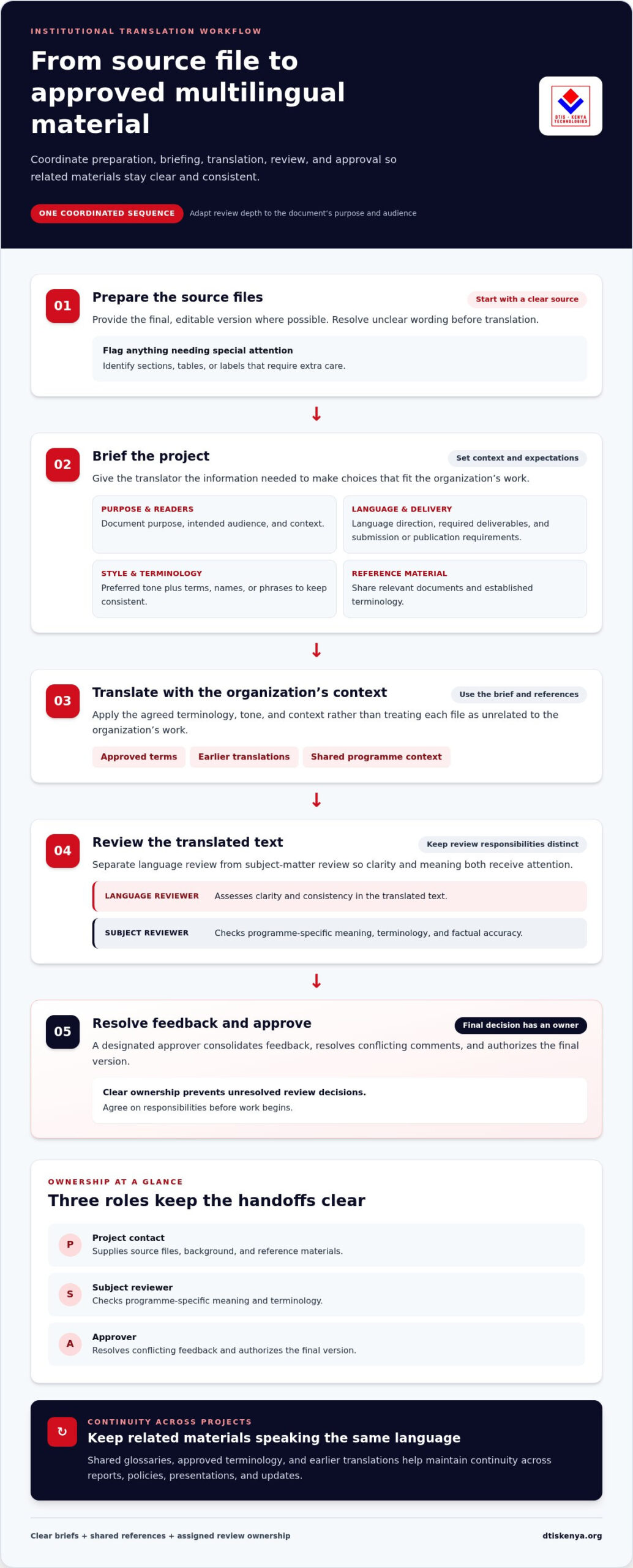
- Project contact: supplies source files, background, and reference materials.
- Subject reviewer: checks programme-specific meaning and terminology.
- Approver: resolves conflicting feedback and authorizes the final version.
With responsibilities agreed in advance, translation services for international organizations Kenya teams rely on can fit more smoothly into recurring programme and administrative schedules. The organization retains control of its message while reducing preventable review delays.
How to Maintain Terminology and Review Quality Across Translated Materials
Consistent translation depends on more than the wording of an individual file. A shared process helps teams carry approved terms across reports, policies, presentations, and future updates, while making clear who resolves questions and who signs off. A defined workflow is central to translation services for international organizations Kenya teams use to coordinate recurring materials.
Approved terminology gives institutional documents a shared vocabulary, helping readers recognize the same programmes, roles, and concepts across languages and formats.
Use this sequence for each project, adapting the level of review to the document’s purpose and audience:
- Prepare source files. Provide the final, editable version where possible, and identify sections, tables, or labels that need special attention. Resolve unclear wording in the source before translation.
- Brief the project. State the document’s purpose, intended readers, language direction, required deliverables, and submission or publication requirements. Share relevant reference materials and established terms.
- Translate. The translator uses the brief and available references to guide word choices, tone, and context, rather than treating the file as unrelated to the organization’s work.
- Review the translated text. Separate linguistic review from subject-matter review. A language reviewer assesses clarity and consistency, while an organizational specialist checks programme facts and technical meaning.
- Approve and record decisions. A designated approver resolves outstanding comments and authorizes the final version. Record newly agreed terms so they can guide later documents.
How should an organization prepare a translation brief?
A useful brief answers practical questions before work begins: What is the document for? Who will read it? What are the source and target languages? Which files and formats are required? Include a glossary, prior approved translations, style guidance, names, titles, or reference documents where available. State the deadline, review contacts, final approver, and any submission or publication requirements. For a document with a formal purpose, explain how it will be used so the appropriate translation format can be selected.
How can internal review support accurate institutional language?
Reviewers are most effective when their roles are distinct. A linguistic reviewer focuses on whether the translation reads clearly and uses terms consistently; a subject-matter reviewer checks facts, programme meaning, names, and titles. They should send comments through one project contact, who consolidates feedback and refers unresolved terminology questions to the appropriate organizational lead. This prevents competing edits from circulating without a clear decision.
Once the approver accepts a term, add it to the organization’s preferred terminology list and apply it to related materials. For recurring document translation support, this documented process gives teams a practical starting point for consistent briefs, reviews, and approvals.
Which Language Service Fits Your Organization’s Deliverable?
Start with the form of communication and the intended outcome. A written report, a live meeting, an audio recording, and a public website each call for a different language service. Matching the deliverable to the service helps teams plan the right work instead of treating every multilingual need as a document translation request.
| Deliverable | Suitable service | Intended organizational use |
|---|---|---|
| Reports, correspondence, presentations, and research | Document translation | Communicate written information in another language while retaining its purpose and meaning. |
| Formal documents that require a certified translation | Certified document translation | Prepare a translated document for submission where the receiving institution requires certification. |
| Meetings, consultations, and events | Interpretation | Support spoken multilingual communication as participants speak. |
| Recorded speeches, interviews, or discussions | Transcription | Convert recorded speech into written text for organizational use. |
| Websites and other digital content | Website or content localization | Adapt material for a target audience, including context and presentation as well as language. |
When is document translation or certified translation appropriate?
Use document translation for written materials such as organizational reports, correspondence, presentations, and research. The brief can explain the audience, purpose, and established terminology so the translated text fits its intended use. Certified translation is appropriate when a formal document requires a certified translation. The receiving institution’s stated requirements determine whether additional formalities are needed.
The formality of a document alone doesn’t establish which process is required. An internal policy and a document submitted to an external institution may need different handling. Match the service to the document’s purpose rather than assuming all organizational files require certification.
When should an organization consider interpretation, transcription, or localization?
Choose interpretation for spoken communication at meetings or events where participants need to communicate across languages in real time. Interpretation equipment rental can also support event arrangements where equipment is needed. Transcription serves a different purpose: it turns recorded speech into text that teams can use as a written record or source material.
Localization suits websites and digital content intended for audiences in different markets. Rather than translating words alone, it adapts content to the audience and context, helping information remain relevant and understandable. For example, a public-facing web page may need its terminology, examples, and calls to action reviewed for the intended readership while preserving the organization’s core message.
For teams evaluating translation services for international organizations Kenya, the deliverable is a practical starting point: identify whether the need is written, spoken, recorded, or digital, then define its audience and intended use. This match helps shape a focused project brief and keeps the chosen service aligned with the communication task.
How to Brief and Coordinate an Institutional Translation Project
A clear project brief gives the language team the context to work from and gives organizational reviewers a shared basis for decisions. Before sending files, gather the information that defines the work, including its purpose, audience, language direction, deadlines, and final use. This preparation prevents avoidable questions and keeps review aligned with programme needs.
What information should the project brief contain?
Record the material type, intended readers, source and target languages, and how the translated content will be used. Note whether the deliverable is for internal circulation, a stakeholder meeting, publication, or formal submission, since purpose affects tone, format, and review. Where possible, provide editable source files alongside relevant background documents, glossaries, approved terminology, and earlier translations.
Use this checklist to assemble a practical handover:
- Source materials: Include the current version of each file and identify the authoritative copy if several drafts exist.
- Audience and purpose: Describe who will use the material and what they need to understand or do.
- Language needs: Specify the source and target language direction for each deliverable.
- Deadlines and stages: Set the required delivery date and allow time for organizational review and approval.
- Deliverables and format: List the files or formats required, along with any submission or publication instructions.
- Review ownership: Name the project contact, relevant subject reviewers, and final approver.
If several documents belong to one programme, share them together where practical. A policy, presentation, and report may use the same programme names and technical terms; reviewing them as connected materials gives the team useful context and helps preserve consistent wording. Identify which files are final and which are references so background material isn’t mistaken for content to translate.
How can teams keep a project moving through review?
Assign responsibilities before the translated draft arrives. A programme lead can clarify activities and terminology, a communications reviewer can assess audience and tone, and a designated approver can settle final decisions. For a smaller project, one person may hold more than one role, but decision-making responsibility should still be explicit.
Ask reviewers to submit comments through one organizational contact rather than returning separate, conflicting instruction sets. That contact can consolidate edits, distinguish factual corrections from stylistic preferences, and route unresolved questions to the person authorized to decide. Keep a record of agreed terms, names, titles, and programme labels alongside the project files. This gives subsequent updates a dependable reference and reduces the need to revisit settled decisions.
For translation services for international organizations Kenya teams can coordinate with a clear brief and review structure, DTIS-Kenya Technologies provides document translation and related language services. Discuss your translation project with the team to plan a suitable project handover.
How DTIS-Kenya Technologies Supports Organizations With Translation in Kenya
Institutional communication often spans written documents, meetings, recorded discussions, and digital channels. DTIS-Kenya Technologies provides document translation and certified document translation, alongside language services that support different parts of an organization’s multilingual work. Matching each deliverable to the appropriate service helps teams plan a coherent project rather than treating every communication need as a separate task.
A connected range of language services for institutional work
For written materials, document translation supports reports, correspondence, policies, and other organizational documents. Certified document translation is available for formal documents that require certification. Interpretation supports spoken communication at meetings and events, while transcription turns recorded speech into written text. Website and content localization adapt digital material for its intended audience, considering context and presentation as well as wording.
These services can complement one another within a programme. An organization might translate a written report, arrange interpretation for a related meeting, transcribe recorded discussions, and localize selected digital content. Each has a distinct deliverable, so identifying the communication task at the outset helps define the scope and coordinate connected materials. DTIS-Kenya Technologies provides these services in Kenya.
For teams considering translation services for international organizations Kenya requires, start by mapping the work to its intended audience and format:
- Written communication: Identify documents for translation and distinguish any that require certified translation.
- Live communication: Describe meetings or events where participants need spoken language support.
- Recorded communication: Specify recordings that need to be converted into written text through transcription.
- Digital communication: Identify websites or other content that should be adapted for a target audience.
Prepare to discuss your organization’s translation needs
A concise project overview makes the first discussion more focused. Gather the source materials, explain their purpose and intended audiences, specify language needs, and note the relevant deadlines. If documents are connected, share them as a group where practical, and indicate which files are final or reference materials. This gives the project a clear foundation from the outset.
Also outline who will review terminology, answer subject-matter questions, consolidate comments, and approve final deliverables. Clear ownership keeps related materials aligned and gives reviewers a defined route for resolving decisions. DTIS-Kenya Technologies also creates employment opportunities for women, youth, and refugees, reflecting a social-impact purpose alongside its language services.
To discuss your organization’s translation project, prepare these requirements and share your project details with DTIS-Kenya Technologies through its website.
Make Multilingual Communication Part of Your Next Planning Cycle
As your organization plans its next programme or reporting cycle, build language access into communications from the outset rather than arranging it only when a deadline is close. Identify which audiences need to receive information, what materials will support that work, and how translation planning fits alongside programme and communications decisions. This forward-looking approach makes translation services for international organizations Kenya a considered part of institutional planning.
Begin with one upcoming project. Bring together its source materials, intended audiences, language requirements, and internal review responsibilities, then outline the support your team needs. A focused discussion can turn those requirements into a practical project plan with a clear path from brief to delivery.
DTIS-Kenya Technologies supports organizations with language services for written, spoken, recorded, and digital communication. Discuss your organization’s translation requirements with DTIS-Kenya Technologies and take a considered next step toward more inclusive communication. With the right planning, your organization can help its work reach people with clarity and respect.
Frequently Asked Questions
What documents do international organizations commonly translate in Kenya?
Common materials include reports, research, presentations, policies, correspondence, and stakeholder communications. Consider how the documents work together: a translated research summary may need to use the same programme names as its accompanying presentation. Grouping related materials in the project scope helps preserve those connections. The intended readers and use also matter, since a document for public distribution may call for a different approach from an internal working paper.
Does every organizational document need certified translation?
No. Certification is relevant when the intended use or receiving institution calls for a certified translation. A presentation prepared for an internal meeting may have different requirements from a formal document submitted to an institution. Identify the destination and purpose, then use the recipient’s stated requirements to guide the request. This avoids treating certification as the default for every file in a multilingual project.
How can an organization keep terminology consistent across translated documents?
Give terminology decisions a clear owner and keep a record that distinguishes approved terms from wording still under discussion. For example, if a programme title has an official version, record it alongside any acceptable shortened form and the context for each. Share that record with the relevant project team and update it when an authorized decision changes. This reference helps prevent conflicting choices across future materials.
What is the difference between translation and interpretation for an organization?
Translation is for written content, while interpretation supports spoken communication. A team preparing a written briefing for an event may need translation for the document and interpretation for discussion among participants. Planning these as separate requirements clarifies what the audience needs before, during, and after the event. It also lets the organization specify written files and live communication arrangements as distinct deliverables.
Can one language-services project include transcription and localization as well as translation?
Yes. A project can combine services when its outputs require them. For instance, an organization producing an online information session might need a written resource translated, a recording transcribed, and related web content localized for its audience. List each output separately and identify where it will appear or be used. That distinction gives reviewers a clear way to assess each deliverable against its purpose.
What should we provide when requesting translation services for an organization?
Alongside the source file and project purpose, include a clear file name or version identifier so the team works from the correct draft. Note any tables, appendices, captions, or other elements that are part of the requested deliverable. For translation services for international organizations Kenya teams coordinate, identifying the audience, language direction, output format, and review contacts also helps define a complete handover.
How do organizations decide whether a translation is ready for publication?
Use a final release check that reflects where the material will appear. Confirm that the approved version is being used, that figures, captions, footnotes, and document references remain present, and that editorial comments or tracked changes have been resolved. For an external submission, compare the finished material with the recipient’s instructions. A named approver should authorize release, keeping publication decisions clear and documented.
Certified Legal Document Translation In Kenya: A Practical Checklist
22/10/2026 12:00 pm[…] This preparation makes the request easier to understand and keeps important context with the source documents. It also gives you a useful record of what was supplied and which recipient instructions informed the request. For organizations coordinating terminology, reviewers and delivery across multilingual projects, see this guide to translation services for international organizations in Kenya. […]