

The best French translator is one who understands your document’s purpose, conveys its meaning accurately in French, and adapts the wording to its intended reader; for English-to-French translation in Kenya, these choices matter as much as fluency. A text for a business, institution, legal matter, or personal use may call for a different register and level of formality, so providing the source text and relevant context helps the translator produce a suitable result. This guide explains what to consider when choosing a French translator, what to include when requesting an English-to-French text translation, which factors shape the process, and how to approach urgent needs in Kenya and across Eastern Africa, helping you identify the right service for your purpose and move forward with clear expectations.
Key Takeaways
- Choose a French translator based on the document’s purpose, required register, and whether you need certified document translation.
- Share the source text, intended audience, and context to help shape an accurate English-to-French translation.
- For urgent work in Kenya or Eastern Africa, clarify the deadline and the materials that need translation so the request can be planned appropriately.
- When a Kenyan document needs certification or notarization, establish the receiving institution’s requirements before the translation process begins.
What is the best French translator?
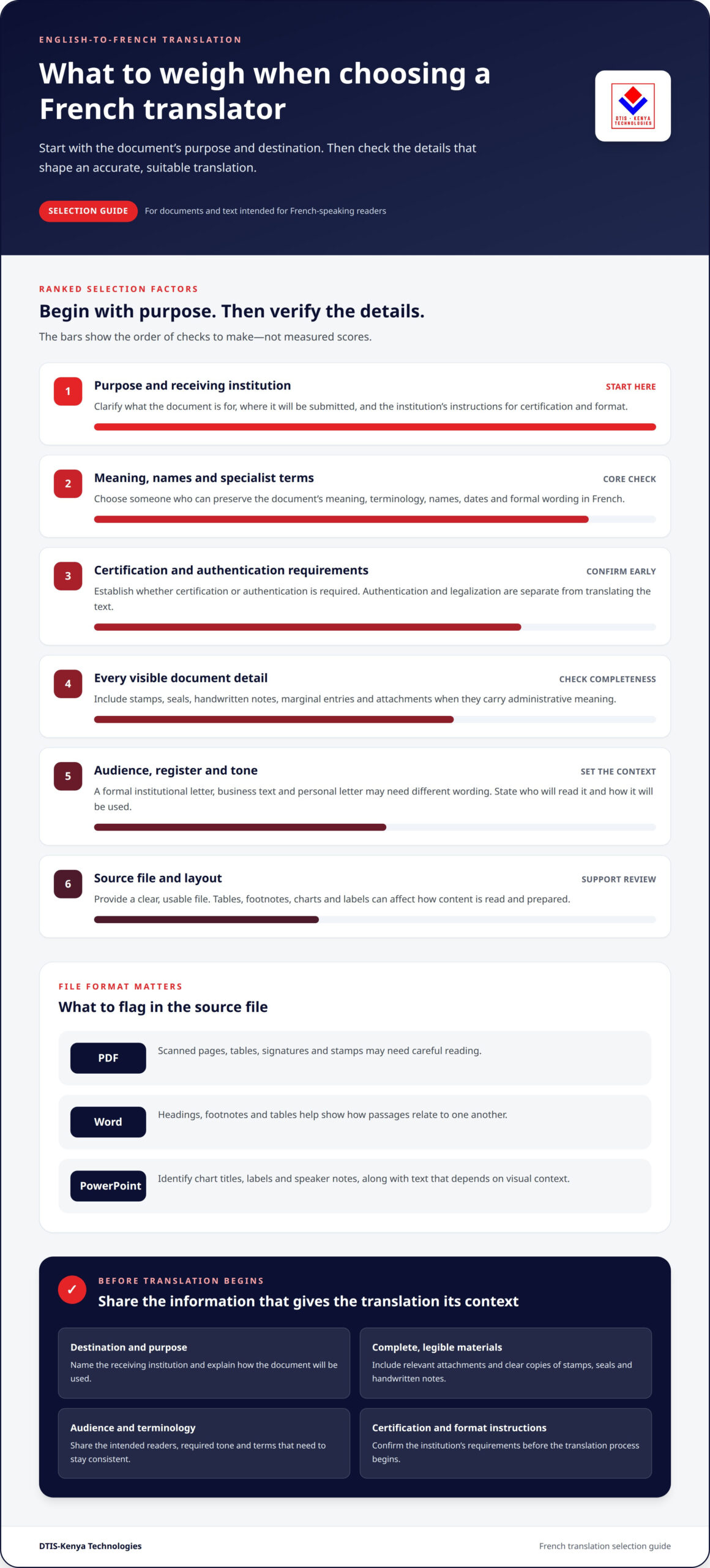
For certified English-to-French or French-to-English document translation, choose a translator who understands the document’s purpose, terminology and receiving institution. A birth or marriage record, bank statement, school diploma, visa file and permit each contain specific names, dates and formal wording. Those details need to be preserved accurately in the other language. Before work begins, identify the receiving institution and its instructions for certification and format. This helps ensure the translation is prepared for its intended use, whether an application, official record or financial review.
Check whether documents intended for use in another country need authentication in the country where they were issued. If the host country’s official language is not English, the document and its authentication stamps will almost always need translation. Stamps, seals, handwritten notes, and marginal entries can carry administrative meaning, so they should be considered alongside the main text. For example, a translated diploma may need its attached verification stamps rendered as well. Keeping these elements together helps preserve the record’s context for the receiving authority.
PDF, Word and PowerPoint files each present different translation considerations. A PDF may contain scanned pages, tables, signatures or stamps that require careful reading. Word files often include headings, footnotes and tables, while PowerPoint presentations pair concise text with charts and labels. Identify all visible text and provide clear files so labels and visual context can be understood. Translating a chart title without its legend, for example, could leave the figures unclear. File format affects how the content is reviewed and prepared.
Medical, immigration and finance documents call for precise handling of specialist terms. A medical report may include diagnoses and treatment details, an immigration file may contain identity records and permits, and a bank statement uses transaction labels and account terminology. Authentication and legalization are separate from translating the text; the receiving institution’s instructions determine which steps apply. For a cross-border submission, establish the destination and purpose first, then include the document and relevant stamps in your translation request. This helps avoid missing attachments or administrative markings.
English-to-French text translation
English-to-French text translation carries the source meaning into French while fitting its purpose and readers. A company profile for Nairobi partners needs a different register from a personal letter. The translator considers the intended audience, the communication setting, and any established terminology. This context helps resolve phrases that have several possible meanings in English. For example, “the board” may refer to a governing group or a physical sign. Knowing the document’s subject helps preserve the intended meaning.
Provide the source text, its intended use and any terminology that must stay consistent. A report for an NGO, a product description and a conference presentation each call for distinct language choices. If the text belongs to an ongoing project, include a previous version to clarify preferred terms and names. This helps keep recurring labels consistent across sections, especially when the same organization, programme or role appears in several documents.
File format also shapes the translation process. In a Word file, headings, tables and footnotes show how passages relate to one another. A PowerPoint presentation may rely on short labels, chart titles and speaker notes. A PDF may arrange text in columns or embed it in graphics. Provide the file in a clear, usable format and identify any content that depends on visual context. This helps ensure headings and captions retain their intended relationship to the main text.
Before translation begins, identify the target readers and the required tone. A formal letter to a public institution calls for different wording from website content aimed at customers. Cultural sensitivity matters too: a direct English phrase may sound overly abrupt when translated literally. A suitable translation preserves the message while adapting expressions to the audience. If you need a text prepared for French-speaking readers, request English-to-French text translation with its intended use and reference materials.
Urgent translation services in Kenya and Eastern Africa
An urgent translation request needs a clear deadline and a defined scope. Identify the document, language direction, intended reader and submission date. A meeting brief for French-speaking delegates, for example, differs from an immigration file due for review. If the full file cannot be processed at once, specify which pages are the priority. This helps the translator plan the work without confusing essential pages with supporting material.
Send the source file in its current format, including attachments and appendices. A scanned letter, spreadsheet and signed agreement each require different review. If a stamp, handwritten note or table is part of the content, provide a legible copy. Missing pages can interrupt the work and leave the French version incomplete. Also share names, job titles, organization names and approved terms that need to remain consistent, such as a project title used across several documents.
Urgency does not remove the need for context. A translator needs to distinguish a firm deadline from an internal target and understand how the translation will be used. A short invitation for a conference in Kenya may contain fewer complex terms than a lengthy technical report. Page count, readability, specialist vocabulary, and document layout all affect the work involved. If a particular section is needed first, identify it clearly so priorities are understood from the outset.
For a translation intended for readers across Kenya, state where it will be submitted or read. A document for a national meeting may have a different audience from correspondence shared with partners elsewhere in the country. Specify the required delivery format and whether the translated file must retain headings, tables or page order. If it forms part of a larger submission, include related materials that explain its terminology. Clear instructions help keep names and key terms aligned across connected files.
When requesting urgent work, send a complete brief in one message: source files, language direction, deadline, intended use and formatting needs. These details help the translator assess the task and plan around its actual requirements, rather than an incomplete description.
How do I get a Kenyan document translated into French and certified or notarized?
Start with the institution receiving your document and ask what it requires for translation, certification, notarization and authentication. These terms describe different parts of document preparation, so follow the institution’s specific instructions. DTIS-Kenya Technologies provides certified document translation, with translations accepted by embassies, immigration offices, universities, courts and other government agencies. Requirements can still vary by destination and document type. A university diploma, marriage record or bank statement may follow different submission procedures, so share the instructions with your translator before work begins.
Use this sequence to organise the request:
- Identify the destination and purpose. Note whether the document is for a school application, immigration file, financial review, or legal proceeding.
- Provide the complete document. Include every page, attachment, seal, stamp, and handwritten entry. Authentication stamps may also need translation when the host country’s official language is not English.
- Request the required translation format. State whether the institution asks for a certified French translation, notarization, or both. Provide its written instructions where available.
- Arrange authentication in the issuing country. Documents intended for use in another country must be authenticated in the country where they were originally issued. For a Kenyan-issued document, that means authentication takes place in Kenya.
Translation, certification, notarization and authentication are separate steps, not interchangeable terms. Translation renders the document’s content in French; the other processes address distinct formal requirements. A receiving authority may also require the original document alongside its translation. For example, a translated marriage record may need to accompany the Kenyan original and relevant authentication stamps. Confirm the required sequence with the receiving institution, since the wrong order can delay submission.
Send the document and the institution’s instructions together for certified document translation. This gives the translator clear guidance on language direction, stamps, and requested format before preparing the French version.
DTIS-Kenya Technologies: Documents Translation
DTIS-Kenya Technologies provides document translation for personal, institutional, and business documents requiring English and French language support. If you are preparing a diploma, official record, or finance document for a French-speaking recipient, share the file and its intended use so the translation can reflect its purpose. Certified French translations are accepted by institutions, supporting formal document submissions.
For related communication needs, DTIS-Kenya Technologies also provides interpretation, interpretation equipment rental and transcription. These services support meetings, events and recorded material when written translation is only part of the assignment. Choose the service that matches your task, whether you need a translated document or support for spoken communication.
To discuss your document translation needs, contact DTIS-Kenya Technologies.
Prepare your next French-language communication
For English to French translation in Kenya, start by defining how the translated material will support your work. A formal letter, briefing and meeting presentation each serve a different purpose, so identifying the audience and intended use helps guide the language choices. If your work also involves spoken communication, consider how translated documents and live discussions can deliver a consistent message.
DTIS-Kenya Technologies provides document translation, interpretation and interpretation equipment rental. Its services support written material as well as communication for meetings and events, helping you plan related requirements together. When you make a request, share the assignment’s purpose so the team can understand which service you need. The team brings experience in language services to support your requirements.
Contact DTIS-Kenya Technologies to discuss your translation or communication requirements and take the next step with confidence.
Frequently Asked Questions
What are the best English-to-French translation services available in Kenya?
The right service depends on your document, deadline, and intended recipient. DTIS-Kenya Technologies provides certified document translation, with same-day Express Translation for documents under 10 pages and regular translation usually 1 – 3 days, depending on volume. Certified translations are accepted by embassies, immigration offices, universities, courts and other government agencies. Share the document’s purpose and submission deadline when arranging the work.
Where can I find certified English-to-French translators in Nairobi and other Kenyan cities?
Arrange certified English-to-French translation for use across Kenya with DTIS-Kenya Technologies, which serves customers nationally. Describe the document’s purpose and receiving institution, particularly if it contains specialist terminology or supporting records. Certified translations are accepted by embassies, immigration offices, universities, courts and other government agencies, making them suitable for formal submissions.
Do Kenyan authorities require certified French translations for official documents?
Requirements depend on the receiving authority and the document’s intended use, so do not assume every submission needs the same format. Ask the receiving office what it requires for your file, including whether certification or other formal steps are needed. DTIS-Kenya Technologies’ certified translations are accepted by embassies, immigration offices, universities, courts and other government agencies.
Which English-to-French translation option is best for business, travel, or legal documents in Kenya?
Choose document translation for written material and interpretation for spoken conversations. A business agreement, travel-related record or legal document needs a translator familiar with its subject and intended reader. For negotiations or a meeting, interpretation supports live multilingual communication; for a contract or application, a translated document is the right format. DTIS-Kenya Technologies provides both translation and interpretation for these different communication needs.
What should I check before choosing an English-to-French translator in Kenya?
Confirm the document type and language direction, and explain where the translation will be submitted. Provide any required terminology, reference documents and deadline to define the scope. For official use, distinguish certification from notarization or authentication, since these are separate formal steps. You can also specify how the completed file should be delivered, especially if layout or attachments matter.
Multilingual Airport Transfers In Kenya With Language Support
28/11/2026 10:00 am[…] Technologies provides certified document translations accepted by embassies, immigration offices, universities, courts and other government agencies. […]