
A literal translation can be legally or technically wrong, even when every word appears accurate. To avoid errors in document translation, preserve the source meaning, account for the legal and cultural context in the destination, and have the work reviewed by someone with relevant subject expertise. The document’s layout matters too: misplaced headings, numbering or figures can create confusion.
For documents intended for use in Kenya, accuracy depends on more than fluency. Reviewers need to check terminology, context, and consistency, while translators must account for the document’s purpose and audience. This article explains how to avoid errors in document translation, including common mistakes in legal and technical documents, the effects of jurisdictional and cultural differences, and the role of expert review and layout checks.
Key Takeaways
- Account for differences between legal systems and cultural conventions so translated wording fits its intended use in Kenya.
- Use consistent terminology management, including glossaries, to reduce conflicting terms across related documents.
- Build review around the right expertise, with linguistic, subject-matter and formatting checks serving distinct quality roles.
- Give the translation team the document’s purpose, audience and reference materials so the final version is clear and usable.
1. Accounting for cultural and jurisdictional differences
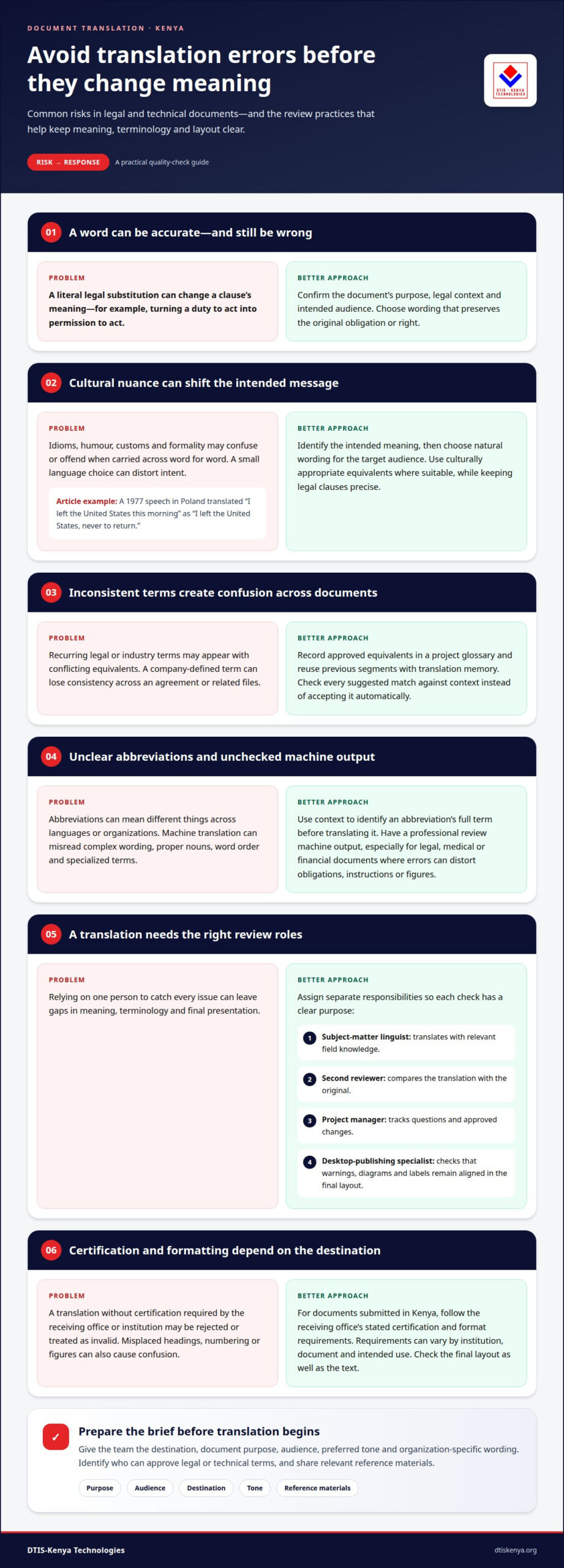
Legal translation must preserve meaning across languages and legal systems. A term in a Kenyan contract may have no exact equivalent in another jurisdiction, where the same concept may follow different procedures. Translators need to understand the document’s purpose, legal context, and intended audience. A word-for-word translation can sound correct while changing an obligation or right.
Cultural context matters beyond legal terminology. In a 1977 speech in Poland, former US President Jimmy Carter’s statement, “I left the United States this morning,” was translated as “I left the United States, never to return.” His use of “desire” was also translated as “lust.” These examples show how a seemingly small language choice can distort intent. For a company communicating internationally, comparable errors in a contract, public statement, or product instructions can undermine trust and damage its reputation.
Idioms, humour, customs, and levels of formality need careful handling. A phrase familiar to one audience may confuse or offend another if translated literally. The translator should identify the intended meaning, then choose wording that conveys it naturally in the target language. For example, a joke in an employee handbook may need a culturally appropriate equivalent, while a legal clause requires precise terminology rather than an informal substitute. Careful review also helps identify wording with unintended social or cultural implications.
For legal or government documents submitted in Kenya, follow the receiving office’s stated requirements for certification and format. Requirements can vary by institution, document, and intended use. A translation without required certification may be rejected or treated as invalid.
Before translation begins, clarify the destination, audience, and purpose, such as submission to a Kenyan public office or use in an international contract. These details help translators select suitable terminology and tone, preserve cultural nuances, and communicate the source meaning clearly. When dealing with complex cross-border business or immigration documentation, consulting legal professionals such as Tosolini, Toniutti & Partners can help ensure that jurisdiction-specific terms and regulatory requirements are correctly interpreted.
2. What common mistakes do professional translators avoid when translating legal documents?
Legal translation can go wrong when a familiar term is treated as universal. Legal systems use concepts and procedures that may have no direct equivalents in another jurisdiction. A translator must understand the document’s legal purpose before choosing terminology in the target language. A literal substitution can change a clause’s meaning, for example, by confusing a duty to act with permission to act. Regional dialects matter too: a term used in one community may mean something different elsewhere.
Terminology management helps prevent inconsistencies. A project glossary records approved equivalents for recurring legal and industry-specific terms, while translation memory stores previously translated segments for reuse. The linguist should check each suggested match against the document’s context rather than accept it automatically. For example, a company’s defined term should remain consistent throughout an agreement, even if ordinary language offers several alternatives. This matters especially when multiple documents form part of one transaction.
Abbreviations need the same care. Medical abbreviations can have different meanings across languages, while financial or technical shorthand may reflect an organization’s internal usage. A translator should identify the full term from context before selecting an equivalent, rather than reproduce an unclear abbreviation. Machine translation can misread complex wording, proper nouns, word order, and specialized terminology. In legal, medical, or financial documents, an unchecked error can distort obligations, instructions, or figures, so machine output needs professional human review. Similarly, for companies navigating cross-border fiscal filings and compliance in Europe or the US, consulting specialists such as cidatax.it helps ensure that technical tax and regulatory terms align with local reporting standards.
In Kenya, use a certified translator when the receiving government office or institution requires a certified translation. Official translations may be rejected or treated as invalid without the required certification, so the destination’s stated submission requirements matter. Certification does not replace subject knowledge: the translator still needs to preserve legal meaning and consistent terminology. For documents requiring professional handling, document translation services can support a careful translation process from source text to reviewed version.
3. Assembling linguists, reviewers, project managers and DTP experts
A reliable review process assigns distinct responsibilities rather than asking one person to catch every mistake. A subject-matter linguist translates, a second reviewer compares the translation with the original, and a project manager tracks questions and approved changes. For a product manual, a desktop-publishing specialist then checks that warnings, diagrams, and labels remain aligned in the final layout. Each role addresses a different source of risk.
To assess a document translator’s qualifications, review relevant language credentials or accreditations and ask about experience in the document’s field. Someone translating a medical consent form, for example, needs language proficiency and familiarity with medical terminology. References or previous work in a comparable subject can help demonstrate practical experience. Establish who will handle specialized terms and who will provide independent quality assurance.
Set up the client-side review team before translation begins. Identify who can approve legal or technical terms, and give the translator the document’s purpose, audience, preferred tone, and any organization-specific wording. For a public notice, a local reviewer can flag phrasing with unintended cultural implications. Early communication helps the team resolve sensitive wording before it appears across several files.
Quality assurance should include separate checks for spelling and grammar, terminology consistency, and whether the translation conveys the original intent. Reviewers should record corrections clearly so the linguist can distinguish required changes from stylistic preferences. If a literal translation of a warning sounds unclear, the reviewer can explain the intended meaning and approve a natural alternative. A desktop-publishing review then checks headings, numbering, logos, and text placement. This coordinated process helps catch avoidable mistakes before the translated document is issued.
4. How can you work with a professional to prepare a document and reduce translation errors?
A professional translator needs to know the document’s purpose, audience, and destination before work begins. Explain whether it is a contract, user guide, or submission for a Kenyan institution. This context helps the translator interpret instructions, select suitable terminology, and preserve the source’s tone. Allowing time to understand the material also reduces rushed assumptions about unclear passages.
Provide editable source files where possible, along with reference documents explaining names, abbreviations, and specialized terms. An organization-specific glossary can record preferred translations for recurring terms, while previously approved materials can guide consistent wording. For example, a company may use one defined term throughout a contract and related notices. The translator can then apply it consistently across separate files.
Dates, figures, and measurements deserve particular attention. Date formats may place the day or month first, while number separators can change how readers interpret decimals. A format such as “13/07/2025 [July 13, 2025]” can clarify a date if the receiving authority allows it. The translation professional should preserve essential values and clarify ambiguous formats without changing their meaning.
Document design also affects accuracy. Legal translations should retain headings, sections, and numbering systems, so references remain easy to follow. Translated text can expand by 20-30 percent, depending on the language, so the layout should leave room for longer wording. A desktop-publishing review can identify overflow, broken tables, misplaced labels, and text that no longer matches a diagram.
Before final delivery, the professional can compare the completed translation with the source, review terminology, and check formatting. Provide consolidated feedback through the designated reviewer, rather than sending conflicting edits from several people. This keeps decisions traceable and helps preserve approved wording across document versions. For support with a document prepared for translation, submit your document for professional translation.
DTIS-Kenya Technologies: Documents Translation
DTIS-Kenya Technologies provides document translation for individuals and organizations preparing legal, technical, or official material in another language. The service is useful when accuracy depends on preserving specialized terminology, the document’s purpose, and its intended audience. Certified document translation is also available when certification is required.
To get started, provide the source document and explain its destination, intended use, and any relevant terminology or formatting requirements. This context helps guide the translation and keep the final document aligned with its purpose. For related communication needs, DTIS-Kenya Technologies also provides interpretation, interpretation equipment rental in Kenya for small meetings, and transcription.
For a translation project, contact DTIS-Kenya Technologies to discuss your document’s requirements.
Keep translated documents reliable as they evolve
A translation remains useful only while it reflects the current source. If a contract, policy, or technical guide changes, treat its translation as part of the same document lifecycle. Keep the approved source and translation clearly paired, record revisions, and send updated passages for professional review. This helps prevent outdated clauses or instructions from remaining in circulation.
A practical way to avoid errors in document translation is to assign clear responsibility for updates. Appoint someone to notify the translation team when approved source text changes, and retain terminology decisions that still apply. This creates continuity across future revisions without treating earlier translations as permanently current.
When you’re ready to prepare a document for translation or update an existing version, contact DTIS-Kenya Technologies today. A carefully managed translation process can support clear communication as your documents move across languages and audiences.
Frequently Asked Questions
What common mistakes do professional translators avoid when translating legal documents?
Professional translators check for omissions, inconsistent defined terms, and broken cross-references. For example, if an agreement refers to “Schedule A,” the translation must preserve that reference and include the matching schedule. Translators also compare names, dates, amounts, and negations with the source, since a missing “not” can reverse a clause. Reviewing appendices and amendments alongside the main text helps keep related provisions aligned.
How Can Inaccurate Translations Impact Legal Outcomes?
An inaccurate translation can make an obligation, deadline, or permitted action appear different from the source. If a payment condition is mistranslated, parties may disagree about when payment is due. If a party’s name is inconsistent, identifying the intended party can become harder. Such discrepancies may prompt disputes, delay decisions, or require clarification. The impact depends on the wording, document purpose, and how others rely on it.
How can businesses ensure accuracy when commissioning legal document translation?
Businesses should provide the complete source document, identify its intended recipient, and explain how it will be used, such as for a court filing or contract negotiation. Include related schedules and amendments so references can be checked in context. DTIS-Kenya Technologies’ translations are certified and accepted by embassies, immigration offices, universities, courts, and other government agencies, supporting organizations preparing documents for official use.
Literal Translation: What Could Possibly Go Wrong?
Literal wording can preserve individual words while changing a legal concept. For example, “consideration” in a contract may mean something exchanged by the parties, not careful thought. Translating it according to its everyday meaning could obscure the clause’s function. A qualified translator interprets the phrase in the context of its sentence and document, then chooses wording that conveys the intended legal effect in the target language.
Why Is Cultural Context Crucial in Legal Translations?
Cultural context helps clarify how formal expressions, titles, and references will be understood by their intended readers. A form of address used in one jurisdiction may sound unfamiliar or convey a different level of formality elsewhere. In a witness statement, for instance, preserving a respectful tone must not add deference or change the speaker’s meaning. Context-aware wording supports comprehension while keeping the source’s substance intact.
What are the most common errors in document translation?
Common errors include omitted text, inconsistent names, mistranslated abbreviations, incorrect figures, and formatting that separates labels from their explanations. To avoid errors in document translation, review tables, footnotes, headers, and version identifiers as well as the main text. In a technical report, a translated label beside the wrong diagram can mislead readers even when the sentence itself is accurate.