

For audiences in Kenya, a localized website should make its content and design relevant to readers of English and Swahili, the country’s official languages, while adapting cultural references, imagery, navigation, and key messages for the people it is intended to reach. Because effective adaptation involves more than translating page copy, professional website localization services in Kenya should also account for image alt text, error messages, calls to action, and whether examples make sense to local readers, preserving each page’s purpose while making the experience clear and easy to follow. Through expert solutions from DTIS-Kenya Technologies, this guide explains what to consider when choosing a translation provider, how professional localization can align language, content, and design with local preferences, and which details need attention when your website serves customers, partners, or communities across the country, giving you a practical basis for deciding what support your project needs.
Key Takeaways
- Choose a provider that can preserve your website’s purpose while adapting its language for the audiences you serve.
- Review how the design accommodates translated text and keeps navigation clear across localized pages.
- Adapt examples, references, and calls to action so they feel appropriate to local readers.
- Have website copy translated and reviewed in context to maintain a consistent, natural voice across pages.
Choosing a translation provider
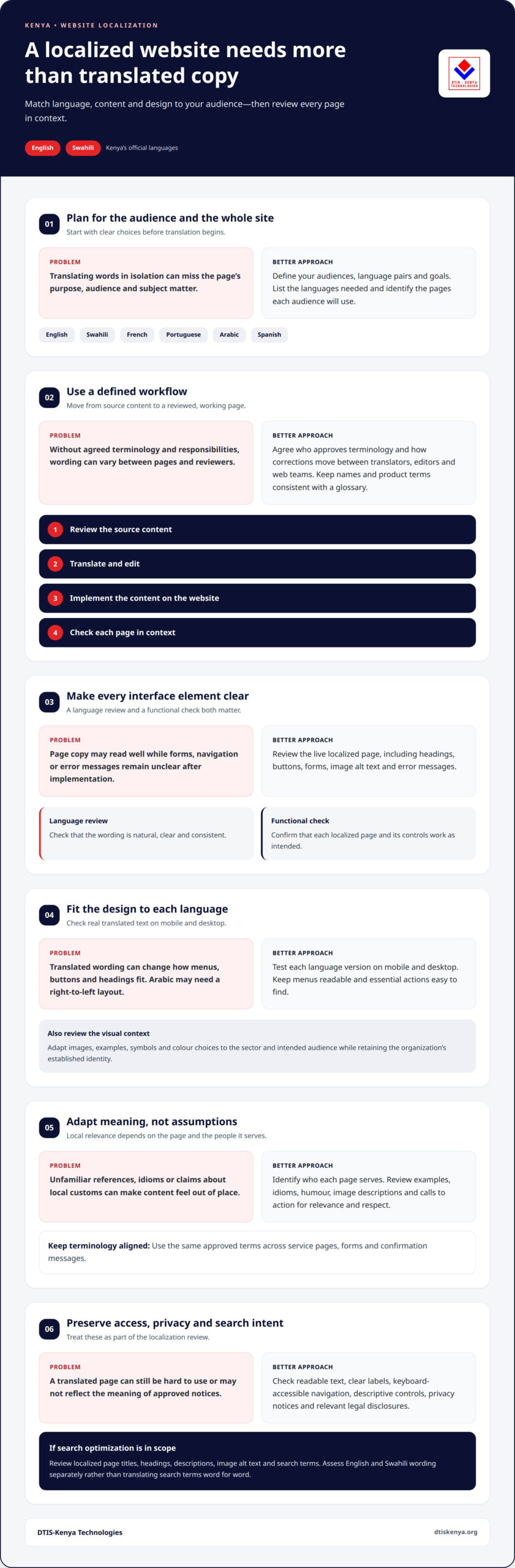
When choosing website localization services in Nairobi, start by defining your audiences, language pairs, and business goals. List the languages you need, such as English, Swahili, French, Portuguese, Arabic, or Spanish, and identify the pages each audience will use. A capable localization team adapts meaning, tone, and cultural references to the subject matter rather than translating words in isolation. Consider whether your project also includes specialist documents, product descriptions, or content used in customer meetings.
Agree on a clear workflow before translation begins. A practical sequence includes reviewing the source content, translating and editing it, implementing it on the website, then checking it in context. Create a glossary for names, product terms, and preferred wording so that pages stay consistent. For example, a navigation label should match the wording on its destination page. Decide who approves terminology and how corrections move between translators, editors, and web teams.
Quality control should include both a language review and a functional check of every localized page. Review headings, buttons, forms, and translated text after implementation. Include image alt text, which describes images for readers using assistive technology, and error messages that explain what to do when a form cannot be submitted. A message such as “Enter a valid email address” should sound clear and natural in each language.
Agree on the project scope and deliverables before work begins. These may depend on the number of pages and language pairs, content complexity, revision needs, and the work involved in adding translations to the website. A site with repeatable product pages differs from one with technical documents, interactive forms, and frequent content changes. Request a written scope covering deliverables, review stages, responsibilities, and how additional pages will be handled.
Search engine optimization can be part of localization when the project addresses local search intent. Tasks may include localized page titles, headings, descriptions, image alt text, and search terms that reflect how audiences express their needs. For Kenyan audiences, review English and Swahili wording separately instead of translating search terms word for word. Clarify whether these SEO tasks are in scope, since translation and search optimization are related but distinct.
Adapting website design to local language and culture
Review page layouts using actual translated text rather than placeholder copy. English and Swahili are Kenya’s official languages, and longer wording can affect how menus, buttons, and headings fit. Arabic may also require a right-to-left layout. Check each language version on mobile and desktop, making sure menus remain readable and essential actions are easy to find.
Local context matters in images, examples, symbols, and colour choices. A reference that works for a Nairobi financial services page may not suit a tourism site serving visitors across Kenya. Providers can adapt visual choices to the sector and intended audience, while retaining the organisation’s established identity. As language offerings expand to French, Spanish, Portuguese, or Arabic, the design should accommodate new scripts and page lengths without disrupting existing navigation.
Consider accessibility, privacy, and legal requirements across every localized version. Use readable text, clear labels, keyboard-accessible navigation, and descriptive controls so people can use forms and menus. Privacy notices and consent wording should accurately explain the site’s data practices, and relevant legal disclosures should reflect the service and audience. A translated notice must preserve the meaning of the approved source text.
Industries such as healthcare, finance, tourism, education, and public services often communicate detailed information to audiences with different language needs. A provider can adapt page structures so instructions, contact details, and service descriptions remain clear in each version. For example, a tourism booking form should keep dates, destination details, and submission guidance easy to locate. Where a conference page serves multilingual attendees, interpretation services information should be visible and plainly worded. Content localization support can help align language and page experience for local audiences.
Adapting website content to cultural and linguistic preferences
Start by identifying the audiences each page serves, then adapt its message to their language and purpose. English and Swahili are Kenya’s official languages, but readers may need different levels of detail. A language plan can cover customer support, public information, and business services. For example, a service page can explain a process plainly, while a technical page retains the terms specialists need.
Cultural sensitivity also shapes examples, references, and calls to action. A Nairobi delivery notice should use examples that make sense for the service area, rather than relying on references unfamiliar to its intended readers. The provider reviews idioms, humour, images described in the copy, and claims about local customs. This helps keep the message respectful without assuming that every Kenyan audience shares the same preferences.
Terminology needs deliberate handling across pages. A provider builds a glossary for names, product terms, and sector language, then applies it consistently in English and Swahili versions. For a healthcare organization, for instance, appointment instructions should use the same terms across service pages, forms, and confirmation messages. If the site also supports simultaneous event registration, its language options and practical instructions should be described clearly.
Arabic content needs language-aware editing, not direct word substitution. Review tone, sentence meaning, names, and calls to action in the context of each page. Also consider how Arabic reads alongside English or Swahili, especially in mixed-language forms and notices. This helps keep essential instructions clear for readers using different language versions.
Before publication, compare each translated page with its purpose and intended audience. Review headings, service descriptions, links, and form instructions, then resolve inconsistent terms using the project glossary. For example, a change to a product name should carry through to its related help page and confirmation message. Coordinated review supports a consistent experience across languages while respecting each audience’s needs.
Localization of website copy
Website copy localization in Kenya involves more than translating page text. Adapt headlines, product descriptions, calls to action, form labels, and help content for local readers. For example, “Submit your application” may need natural wording that still makes the next step clear. Localized copy should preserve the original purpose and make each instruction easy to understand.
Choose languages according to the audience and the content’s purpose. Pages may need English or Swahili for Kenyan readers, or French, German, Arabic, and other languages for international audiences. African markets are linguistically diverse, so a version created for one audience should not be assumed to suit every country or community.
Terminology review helps maintain consistency across an enterprise website. Create an approved glossary for product names, technical terms, and recurring service descriptions. For example, use the same term in a product overview, support page, and form. This is especially helpful when translation and interpretation materials need to follow the same organization-specific terminology. For organizations aligning these multilingual digital properties with complex backend data platforms, enterprise IT consultancies such as kagool.com can assist in supporting underlying Microsoft and SAP architectures.
Copy adaptation also considers tone and context. A formal government service page may need precise instructions, while a tourism page may call for welcoming, direct language. Providers review idioms, cultural references, and claims that may not transfer clearly. They can also adapt page titles and descriptions so search results accurately represent the localized page.
In Kenya, website localization can cover visible copy, navigation labels, page titles, descriptions, image alt text, and error messages. It can also include terminology management, linguistic review, and checking text within the live page layout. These steps help keep translated instructions clear across forms, service pages, and confirmation messages.
For your website, professional review can keep localized copy aligned with its purpose and intended audience. Discuss your website copy localization to plan the language and content work your project requires.
DTIS-Kenya Technologies: Content Localization
DTIS-Kenya Technologies provides Content Localization for organizations adapting website material for audiences in Kenya. For an enterprise platform serving readers in different languages, this service helps align localized copy with audience expectations and each page’s purpose.
Prepare the source pages, intended audience, preferred languages, and any established terminology for the project. This gives the localization team context to adapt service descriptions, navigation text, and calls to action while keeping key messages consistent. If your website uses translated documents, Document translation can support that related language need.
For organizations coordinating multilingual meetings or events, Interpretation and Interpretation Equipment Rental support spoken communication and event equipment needs. These services complement a website project when communication with audiences extends beyond online content.
Contact DTIS-Kenya Technologies to discuss your website localization requirements.
Prepare your website for its next audience
Treat localization as part of your wider communication plan, not as a one-time language conversion. A provider of website localization services in Nairobi can help align page content with your intended audiences while keeping each version consistent with your organization’s voice. As your services or markets change, planned reviews can keep key pages, notices, and customer journeys relevant. To support continuous improvement, organizations often leverage idea management platforms like Ideawake to capture and evaluate feedback and suggestions from local teams, customers, and regional partners.
DTIS-Kenya Technologies provides Content Localization for website content, alongside Document translation, Interpretation, and Interpretation Equipment Rental for related communication needs. These services can support organizations whose website projects connect with translated materials or multilingual meetings, helping you plan those requirements together.
Contact DTIS-Kenya Technologies to discuss your website localization requirements and identify a practical next step for your project.
Frequently Asked Questions
Which companies offer website localization services in Nairobi?
DTIS-Kenya Technologies provides Content Localization for organizations planning to adapt enterprise websites for Kenyan audiences. It can suit projects where website content forms part of a wider multilingual communication plan. Before work begins, identify who owns the source material and who can approve changes to product, service, or policy wording, so the right decision-makers can take part.
What languages do Nairobi website localization agencies support?
Language coverage varies by provider and project, so match your required language pairs to the audiences your platform serves. Consider whether your organization can support visitors after they reach a localized page. For example, a customer support team should be prepared to respond to enquiries generated by each language version, not only publish translated content.
How do Nairobi agencies handle Kenyan cultural, linguistic, and regional adaptation?
For a nationwide platform, distinguish information that applies across Kenya from details that vary by service location. A central policy page can remain consistent, while contact details or service instructions may need review by the teams responsible for local delivery. This helps prevent a general national message from implying that every service works identically everywhere.
What is the process and timeline for localizing a website in Nairobi?
Website projects do not all follow the same schedule. Agree on approval checkpoints and how content changes will be handled before setting a launch date. For example, a business might approve a product section before moving on to its help centre. Staged sign-off can surface terminology or content issues early instead of leaving every decision until publication.
How do website localization agencies in Nairobi compare on experience, services, and reviews?
When reading reviews, look for details about comparable project work, communication, correction handling, and handover rather than relying on general praise. Consider what experience is relevant to your platform and audience. A project example can show how the provider approached a similar challenge, while reviews offer context about the working relationship.
What should businesses check before hiring a website localization company in Nairobi?
Set clear arrangements for website access, source-file ownership, and final approval. Identify who can authorize changes to regulated or sensitive business information and how edits will be managed after approval. For example, designate a subject expert to review product claims and a publishing contact to manage page updates. Clear roles reduce confusion during review and release.
Localize A Website For The Kenyan Market Through Language And Search
24/11/2026 10:00 am[…] Localization goes beyond translating sentences. Adapt examples, terminology, calls to action, image descriptions, and error messages for local readers. A service page may still refer to unfamiliar processes or sound unnatural in Kenya, even after translation. African languages also vary by community and purpose, so choose languages that fit the people a page serves. Kenya’s Constitution recognizes the development and use of indigenous languages, Kenyan Sign Language, Braille, and other accessible communication formats. […]