
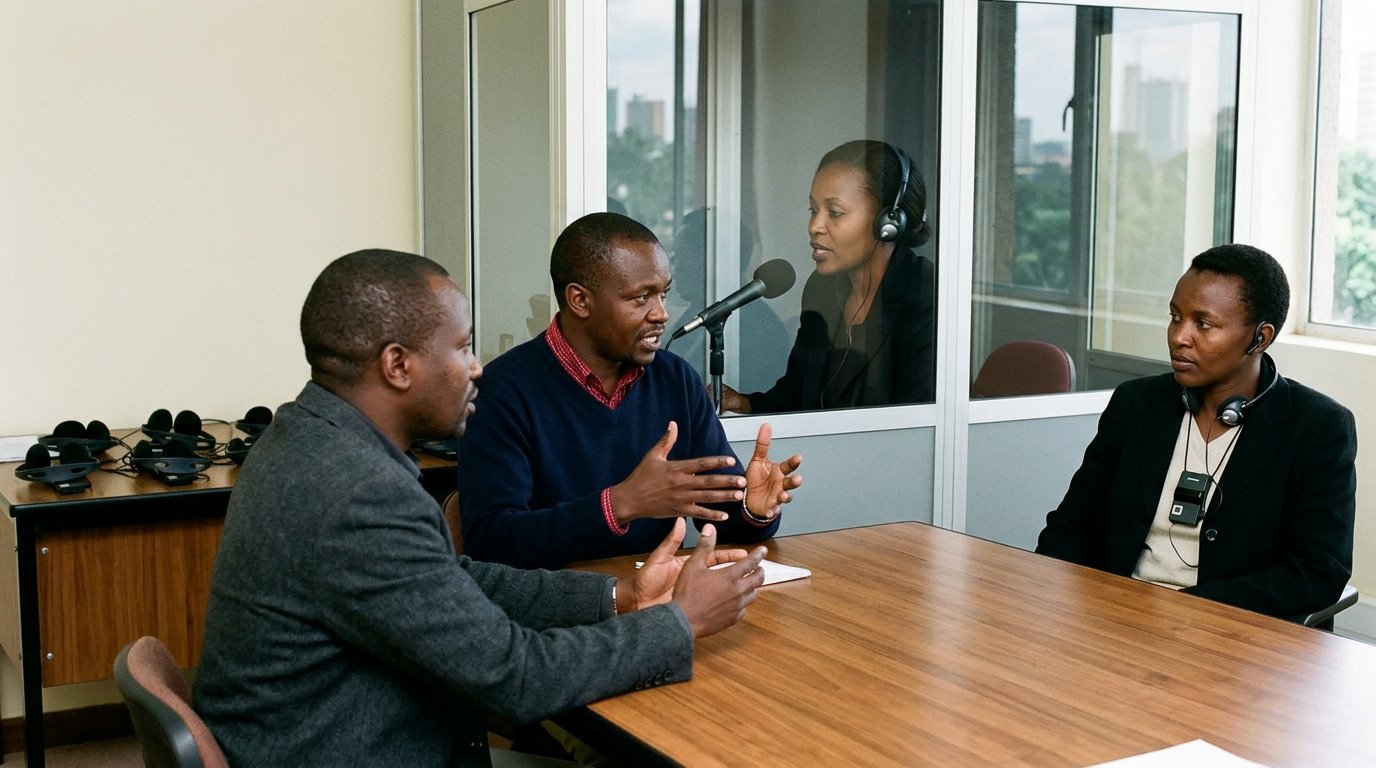
For a meeting in Kenya with participants who speak different languages, a meeting interpreter can use consecutive interpreting, where the speaker pauses between segments, or simultaneous interpreting, which conveys the message while the speaker continues. Both approaches can support in-person, online and hybrid formats. Choosing the right method helps participants follow the discussion and focus on its purpose. This guide explains which approach suits meetings, interviews and press conferences, how interpreting works across formats, and what to consider in business, legal, medical and government settings, including the pace, languages and subject matter.
Key Takeaways
- Choose consecutive interpreting when speakers can pause between segments, and simultaneous interpreting when the discussion needs to continue without interruption.
- Plan interpretation around the meeting format, languages, subject matter and how participants will take part.
- Share the meeting date and time, languages, event type and subject when arranging interpreting support.
- For legal, medical, government or business discussions, match the interpreter’s experience to the setting and the terminology involved.
Consecutive interpreting for meetings, interviews and press conferences
In consecutive interpreting, the speaker pauses so the interpreter can convey each segment. Assess an interpreter’s language proficiency and relevant subject experience; professional association membership or credentials can also inform your decision.
Business Meetings and Interviews
In a business meeting, the interpreter listens, takes notes and speaks during natural pauses. This turn-taking helps participants follow negotiations, interviews and decisions without competing voices. For an English-Swahili discussion, consider the interpreter’s command of both languages and familiarity with the business subject. Sharing an agenda and key terms helps the interpreter prepare.
Meetings, Site Visits and Press Conferences
During a site visit, consecutive interpreting lets a guide explain a process before the interpreter relays each point. At a press conference, the speaker can pause after a response so journalists can hear it in another language. In both settings, consider the pace and sequence of speakers. Sharing relevant terminology helps the interpreter convey technical or public-facing messages clearly.
English-Swahili Interpreting Formats
English-Swahili interpreting can be consecutive or simultaneous. In consecutive mode, the speaker pauses after a short section while the interpreter conveys its meaning. Simultaneous interpreting conveys the message as the speaker continues, with only a brief delay. French or another language pair may also be needed for a multilingual meeting. Written material requires translation, not spoken interpretation.
Choosing Between Consecutive and Simultaneous
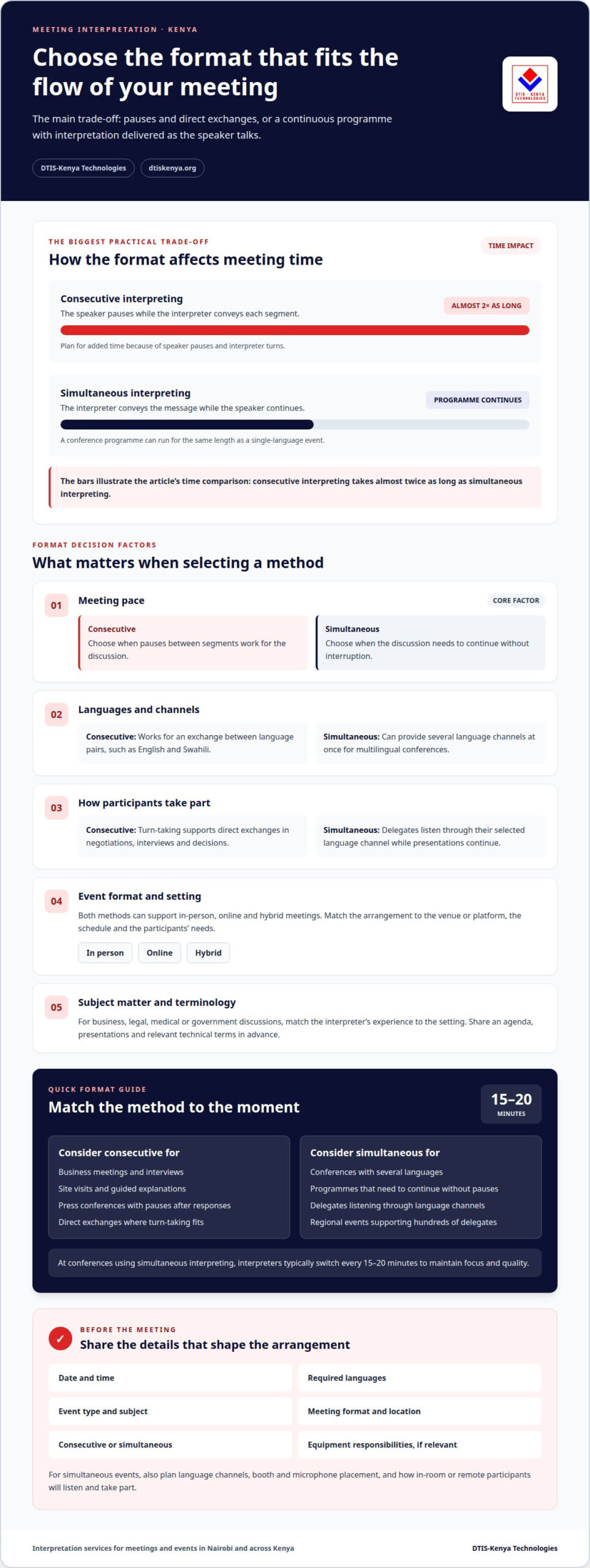
Choose consecutive interpreting when pauses and direct exchanges suit the meeting. It takes almost twice as long to interpret a message as simultaneous interpreting. For a conference that needs to continue without speaker pauses, simultaneous interpreting may be a better fit. It can use booths, headsets and separate language channels. Match the format to the schedule, number of languages and participants’ needs.
Simultaneous interpretation for in-person, online and hybrid meetings
Simultaneous interpreting lets meeting speakers continue while participants hear the message in another language. It suits conferences with several languages, where pauses for consecutive interpreting could disrupt the programme. Delegates can follow through language channels without waiting for each speaker to finish.
For in-person meetings across Kenya, interpretation equipment can include booths, interpreter consoles, receivers and headsets. DTIS-Kenya Technologies offers interpretation equipment rental, supporting interpreters as they convey speech and participants as they listen in their chosen language. The setup depends on the venue and the language channels required.
At a regional conference, simultaneous interpretation can support hundreds of delegates at once. Each participant listens in their selected language, while presentations continue at the scheduled pace. Interpreters typically switch every 15-20 minutes to maintain focus and quality.
Before an in-person event, plan where booths and microphones will go and how delegates will receive headsets. Test the booths, microphones and receivers with interpreters before attendees arrive. This helps identify sound or equipment problems before the programme begins.
For remote meetings on platforms such as Zoom or Google Meet, plan the platform, languages and participant questions. Remote interpreters convey each speaker’s message in real time. Before presentations begin, establish how participants will select a language and ask questions.
A hybrid conference brings together people at a venue and remote attendees. The interpretation plan needs to account for both groups, including how each will hear the target-language channel and join the discussion. Confirm the meeting platform and sound arrangements for in-room and remote speakers.
Simultaneous interpreting can provide several language channels at once, making it suitable for multilingual summits and conferences. The programme can run for the same length as a single-language event. Share presentations and technical terms in advance so interpreters can prepare for the subject matter.
Looking for an interpreter in Nairobi?
To arrange interpretation in Kenya, match the interpreter’s language pair and subject experience to your event. A clear booking brief helps define the assignment.
Local and Nationwide Service Areas
Interpretation can support meetings and events in Nairobi and across Kenya. Share the venue or remote format, event type and subject so arrangements fit the setting. Examples include negotiations, seminars, presentations, company visits and clinic visits. For an event outside Nairobi, include its location and schedule in the booking details. This helps define the assignment’s practical requirements.
Languages and Booking Services
Interpreters in Kenya work in English, Swahili, French, German, Spanish, Arabic, Portuguese and Amharic. In your booking request, state the date and time, required languages, subject and event type. Include the audience’s language needs and whether the meeting is multilingual. For example, a negotiation involving English and Swahili requires a different language pair from a French-language presentation.
Booking Details
Set out the assignment scope in your booking request, including the date, time, language pair, event format and subject. For a conference, specify whether interpretation is consecutive or simultaneous and identify equipment responsibilities. For a site visit, note the location and schedule. These details clarify what the booking covers and help align the interpreting arrangement with the event.
Verifying Interpreter Qualifications
Assess a meeting interpreter by matching language proficiency and relevant subject experience to your event. Ask for examples of similar assignments, such as legal negotiations or medical consultations, and consider professional association membership as supporting evidence. No single credential establishes suitability for every meeting. For your booking with DTIS-Kenya Technologies, confirm the language pair, interpreting format and experience relevant to the audience and subject.
Interpretation for legal, medical, government and business settings
Meeting interpreting in Kenya can support business meetings, negotiations and legal proceedings, as well as medical consultations, conferences and international events. Consecutive interpreting suits discussions with pauses; simultaneous interpreting lets speakers continue. The session’s language pair, format and audience help determine the right approach.
During an English-Swahili business negotiation, an interpreter conveys each speaker’s message and responses. Share the agenda, participant roles and relevant documents before the session to help the interpreter prepare for names and subject-specific terms. For a presentation to international delegates, simultaneous interpreting can help participants follow without pausing for each speaker.
Legal proceedings call for an interpreter familiar with the relevant subject and vocabulary. Medical consultations require careful interpreting of a patient’s account and a clinician’s questions. During a clinic visit, for example, the interpreter conveys the patient’s description and the clinician’s instructions. Written records require translation, which communicates documents; interpretation conveys spoken language.
Government meetings may bring officials and community representatives together across languages. An interpreter can convey points, questions and responses during a consultation or briefing. At an NGO meeting with government partners, the format may be consecutive for discussion or simultaneous for presentations. The participants’ languages and the subject help shape the arrangement.
When selecting a meeting interpreter in Nairobi, consider experience in the setting, proficiency in the required languages and familiarity with the subject. A court-related session, medical consultation and commercial negotiation each involve different terminology. Share the meeting format and relevant terms in advance, so preparation reflects the speakers, documents and purpose of the session.
For a medical-centre appointment, consider whether the interpreter has relevant experience and provides clinic interpreting. When arranging a consultation, explain its subject so the interpreter’s experience can be matched to the work. For other settings, describe the meeting’s specialisation before choosing an interpreter, making the experience you need clear.
Clients seeking an interpreter in Nairobi should choose someone experienced in the required specialisation or a similar subject. A close match can help the interpreter prepare for the meeting’s terminology and purpose. If experience in the exact specialisation is not available, experience in a similar subject is also relevant to the choice.
DTIS-Kenya Technologies
DTIS-Kenya Technologies provides professional interpretation for meetings and related work across Kenya. The appropriate format depends on your participants, language pair, subject and event schedule. Share these details when planning an event so the interpretation arrangement supports the meeting’s communication needs.
For an in-person multilingual event, Interpretation Equipment Rental can support simultaneous interpreting. The equipment may include booths, interpreter consoles, receivers and headsets, depending on the setup required. Sharing the event format, languages, venue details and programme helps establish what the interpretation arrangement needs. For remote or hybrid meetings, include the meeting platform and how participants will follow each language channel.
Written materials may need a different service from spoken interpreting. Document Translation helps convey written content in another language, while Transcription turns spoken material into text. For example, an organization may need meeting documents translated and a recorded discussion transcribed. These services address related language needs without confusing spoken interpretation with written communication.
To prepare for a meeting assignment, gather the date and time, required languages, subject, event type and format. An agenda, speaker list, presentations and relevant terminology can also help the interpreter prepare. If equipment is involved, include the venue and participant arrangements. These details give the team a practical basis for coordinating the requested language support.
To plan interpretation or related language services, contact DTIS-Kenya Technologies.
Frequently Asked Questions
How can I prepare for a meeting interpreter in Nairobi?
Share the language pair, event format, duration, subject and whether interpretation equipment is needed. Provide the meeting schedule and venue or online platform so the interpreter can prepare for your requirements.
Which languages do Nairobi meeting interpreters offer?
Available languages include English, Swahili, French, Spanish, German, Portuguese, Arabic, Somali and Amharic. Support also includes Kenyan languages such as Kikuyu, Luo, Kalenjin and Kisii. State the languages participants need to speak and understand rather than relying on a shared working language. For example, a meeting may require interpretation between Somali and English.
What is the difference between consecutive and simultaneous interpreting for meetings?
In consecutive interpreting, the speaker pauses so the interpreter can convey a completed segment. Simultaneous interpreting relays the message while the speaker continues, making it suitable for a scheduled conference programme. For a negotiation where participants need room to exchange detailed points, pauses may better suit the discussion. Consider the agenda and speaking style when choosing the format.
Can I hire an on-site or remote meeting interpreter in Nairobi?
Yes. Interpretation can be arranged for an in-person meeting or provided remotely for an online session. Hybrid events can include both venue-based and online participants, so plan how each group will hear the interpretation and contribute questions. Share the platform, venue setup and participant arrangements when booking.
How far in advance should I book a meeting interpreter in Nairobi?
Arrange the booking once the date, languages and event format are established. Early planning gives you time to match the interpreter’s subject experience to your agenda and prepare relevant terminology. Allow additional coordination for a multilingual conference or an event requiring equipment. Include the schedule, speaker details and presentations in your planning information.
Multilingual Interpretation For Conferences And Events In Mombasa
18/11/2026 10:00 am[…] a conference or meeting, choose an interpreting format that suits whether participants meet in person, online or in a […]