
A fluent translation is not always enough for an official document. Knowing how to choose a document translator means matching certification and subject expertise to the document’s intended use, then considering quality, cost, timing and file handling.
If a document is going to a court, university or another institution, certification may determine whether it meets submission requirements. The right choice also depends on the language pair, specialist terminology and how clearly the provider explains the process. A low quote or polished review alone won’t tell the whole story.
This guide explains how to assess certification, language expertise, reviews, pricing transparency, turnaround and file-format support. You’ll also learn why scanned or complex files need different handling, and how these factors help you choose a translation service suited to your document and its purpose.
Key Takeaways
- Match the document’s purpose, language pair and certification needs to the translator’s relevant expertise.
- Use reviews and examples of comparable work to assess reliability, then consider how clearly pricing and turnaround are explained.
- Consider whether the file is editable or scanned, since format and layout can affect how the translation is prepared.
- For official documents requiring professional translation, DTIS-Kenya Technologies provides Documents Translation to support a more orderly submission process.
Defining document, language and certification requirements
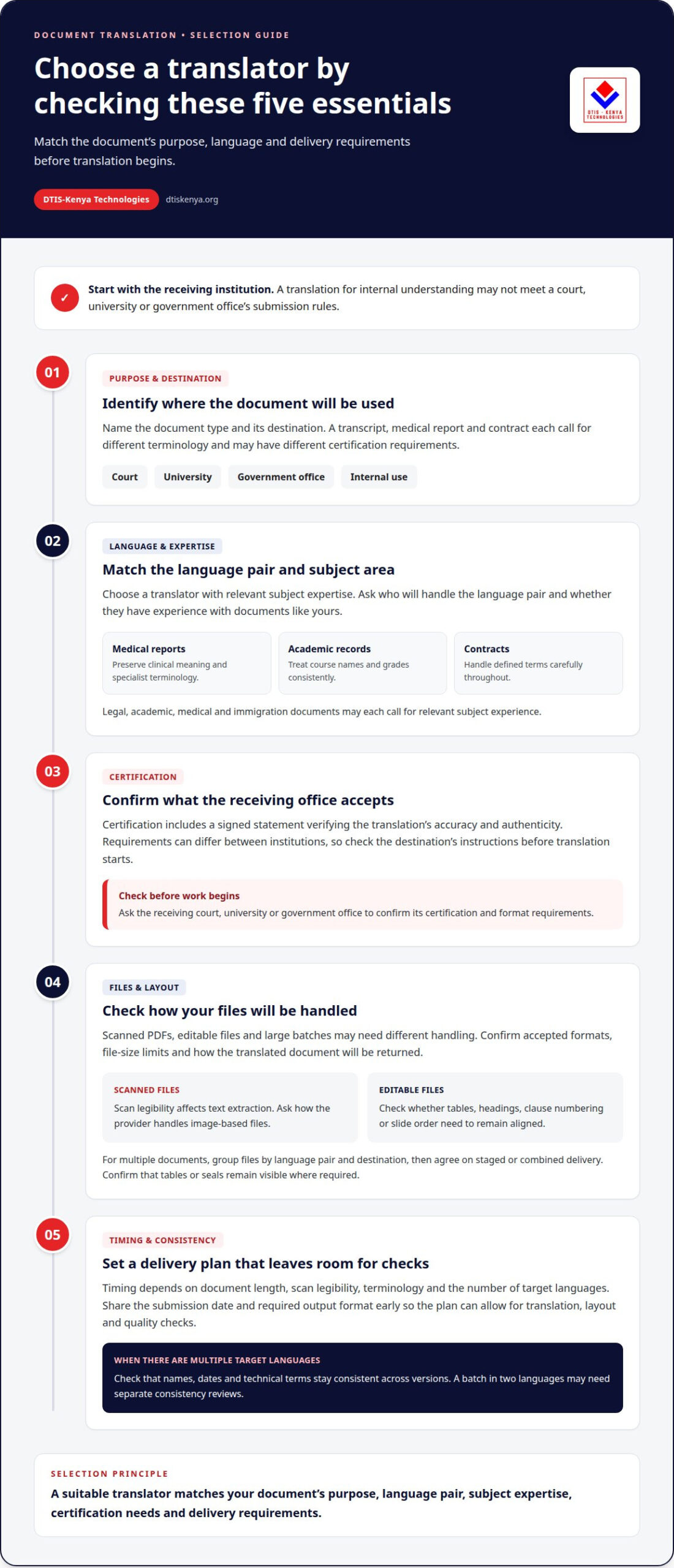
Start with the document’s purpose, language pair and required delivery format. A university transcript, medical report and contract each call for different terminology and may have different certification requirements.
For legal, academic, medical or immigration documents, choose a translator with relevant subject expertise and the required language pair. Find out whether the receiving institution requires a certified translation, which includes a signed statement verifying accuracy and authenticity.
To meet a Kenyan government office, court or university’s requirements, follow that institution’s submission instructions. Confirm its certification and format requirements with the receiving office before translation starts.
Document Types and Certification Needs
Certification means a translation comes with signed verification of its accuracy and authenticity. It matters when a court, university or government office requires official documents to be validated. Medical reports need specialist terminology that preserves clinical meaning; academic transcripts need consistent treatment of course names and grades. Contracts also require defined terms to be handled carefully throughout.
File Requirements and Delivery Timelines
File requirements cover the formats, maximum upload size and layout needed for delivery. Scanned PDFs, editable files and large batches may need different handling. Before work begins, establish which formats the provider accepts, its file-size limit, and whether tables or seals must remain visible. For several documents, group files by language pair and destination, then agree on staged or combined delivery.
Timelines depend on document length, scan legibility, terminology and the number of target languages. A batch of certificates in two languages may need separate consistency reviews. Share the submission date and required output format early, so the delivery plan can allow for translation, layout and quality checks.
Language Regulations and Acceptance
Language compliance means meeting the requirements relevant to the document’s destination and intended use. A translation suitable for internal understanding may not meet an institution’s submission rules. In Kenya, requirements can differ between a university, court and government office, so don’t assume one certification or format suits all three.
For documents in multiple target languages, consistent names, dates and technical terms help prevent conflicting versions. Provide institution-specific terminology and submission instructions with the files. This is particularly useful for medical records and legal documents, where small wording differences can affect meaning. For further guidance on how to avoid errors in document translation, consider how context, terminology and expert review affect accuracy.
Reviews, portfolio, specialization, turnaround time, and pricing
Ask about relevant experience, review procedures, delivery timing, pricing factors and how revisions are handled. The answers help you assess whether the service suits your document’s purpose.
Credentials, Reviews, and Warning Signs
Credentials and client feedback can help you assess a provider’s experience and reliability. Look for examples involving similar documents, such as contracts or academic records, and reviews that discuss accuracy and communication. A portfolio should demonstrate relevant work without exposing confidential details. Vague claims, unclear pricing terms or no explanation of review procedures are reasons to seek clarity before proceeding.
Specialization and Translation Quality
Specialization means familiarity with a field’s terminology, conventions and intended readers. Translating a medical report differs from translating a business policy or contract. Reviews can show whether clients mention consistent terminology, accurate meaning and dependable delivery. For AI-assisted translation, establish whether a qualified human reviews the output and how feedback or requested revisions are handled.
Tone, Turnaround, and Pricing
Tone, timing and price should suit the document’s audience and purpose. A public-facing policy needs clear, professional wording, while a contract calls for precise terminology. Turnaround depends on length, complexity, language pair and review requirements, so agree on a schedule that allows time for quality checks. In Kenya, factors such as word count, language pair, formatting and urgency affect the quote.
Questions Before Hiring
Ask who handles the language pair and subject area, what review process supports accuracy, and whether the final file preserves the required format. Clarify how timing is set, what the quoted price covers, and how revisions are managed. These answers help distinguish a suitable translation service from one that cannot explain its process. For professional document translation support, a clear project brief helps align the work with its intended use.
A provider’s document translation capabilities and file-format support
Document translation involves more than converting words from one file to another. Preserving meaning, tables and headings affects whether the translated document remains usable. For example, a financial spreadsheet needs readable column labels as well as accurately translated entries.
Supported formats determine how a file enters the translation process and how it is returned. PDF, DOCX, XLSX and PPTX are common formats to consider. An editable DOCX differs from an image-based PDF, which needs optical character recognition (OCR) before its text can be translated. Clear scans also help reduce text-extraction errors.
Layout matters in practical ways. A translated contract may need clause numbering and tables to stay aligned, while a presentation needs its headings and slide order preserved. Automated tools can shift spacing, collapse tables or disrupt heading hierarchy. Ask how the provider handles these elements, especially if the delivered file must resemble the original.
How long does document translation usually take in Kenya? Turnaround depends on word count, language pair, file condition, terminology review and layout work. A clean, editable file avoids some preparation needed for a scan, while a large batch or several target languages requires more coordination and review.
Compare providers using the same project details: document type, target language, file format, certification needs and delivery date. Then compare the quoted scope, including formatting, quality review and requested revisions. This is more useful than comparing totals without knowing what work each includes.
Communication is part of a provider’s ability to deliver. A clear process should explain who handles file questions, how terminology changes are recorded and how updates reach you. For an enterprise report with multiple sections, regular progress updates can help teams coordinate approvals and prepare the translated files for use.
Certified translation provider selection criteria
For official submissions, certification can matter as much as translation accuracy. A certified version includes signed verification of accuracy and authenticity. This gives the receiving institution a formal statement about the translation, rather than translated text alone.
Choose a provider with experience in the document’s field, especially for legal material. A contract, court filing and academic record each follow different conventions. Relevant legal experience helps preserve defined terms, clause references and the meaning of obligations. Ask how terminology is managed across related documents, particularly when several versions share terms.
Certification and notarization are distinct requirements. A request for a certified translation does not, by itself, mean notarization is also needed. For a Kenyan court or university submission, follow the receiving institution’s instructions to identify the required form. This helps prevent paying for a step that does not match the stated requirement.
External submissions call for greater consistency and precision than translations intended for internal understanding. A translated contract sent to another party, for example, needs consistent names, dates, defined terms and references throughout. The provider should use the correct source version and keep terminology consistent across related files. If a document has been updated, translating an earlier draft could create conflicting information.
Assess a provider’s record using relevant examples and client feedback. An anonymized legal document sample can show how clauses and headings are handled, while reviews may describe reliability and communication. Clear explanations of certification, review stages and delivery files help you understand what the final version contains. For a multi-document submission, ask how consistency is maintained across the set.
If official paperwork needs a professionally prepared translation, request certified document translation with the receiving institution’s requirements and the correct source version.
DTIS-Kenya Technologies: Documents Translation
DTIS-Kenya Technologies provides Documents Translation for personal, academic and professional documents requiring accurate language transfer. When a submission calls for a certified translation, this service can support the preparation of translated documents for formal use.
Provide the source files, target language, intended use and any receiving-institution instructions when arranging the work. These details help align terminology, formatting and certification with the document’s purpose. For related communication needs, DTIS-Kenya Technologies also offers Interpretation, Interpretation Equipment Rental and Transcription.
For certified document translation in Kenya, contact DTIS-Kenya Technologies to discuss your requirements.
Move Your Document Project Forward
A translation project is easier to manage when its purpose is clear from the start. Before work begins, gather the source document, intended audience and any submission instructions. This gives the translation team a practical foundation for handling the material in context.
Knowing how to choose a document translator can also guide your next decision: whether you need one official document translated, a related set of files, or language support for wider business activities. DTIS-Kenya Technologies provides certified document translation, interpretation and interpretation equipment rental for written and spoken communication needs.
Set out what the document must achieve, then take the next step at a pace that suits your process. Contact DTIS-Kenya Technologies to discuss your document translation requirements.
With a clear brief and a suitable professional service, you can move ahead with confidence and focus on what comes next.
Frequently Asked Questions
What about certified translation?
A certified translation includes a translator’s signed statement verifying accuracy and authenticity. It is useful when an institution requires formal validation, rather than text translated for personal understanding. DTIS-Kenya Technologies’ translations are certified and accepted by embassies, immigration offices, universities, courts, and other government agencies. Match the service to the destination’s submission instructions, especially if the document supports a formal application.
What factors should I consider when choosing a document translation service?
Consider subject expertise, language pair, certification, delivery format, review process, communication, timing and quoted scope. When deciding how to choose a document translator, start with the intended use: a contract for signing calls for precise legal terminology, while a personal letter may need a different review approach. Also consider how terminology will stay consistent across a batch and how updates are managed.
How do I check a document translator’s qualifications and certifications?
Review qualifications relevant to the language pair and subject, then clarify what the final certification contains and who signs it. For a medical report, field-specific experience matters alongside language proficiency; for an academic transcript, familiarity with institutional terminology is useful. Consider a representative sample or feedback about comparable work. Broad claims without relevant examples or a clear review process offer limited evidence of suitability.
How can I compare document translation accuracy and quality?
Compare evidence related to your document type rather than relying on general claims alone. Look for feedback about accurate meaning, consistent terms, clear communication and careful handling of corrections. A similar report or contract sample can show whether headings, tables and formal tone remain coherent. For multi-document projects, ask how terminology decisions are tracked to prevent conflicting translations.
What is the difference between certified, notarized, and sworn translations?
A certified translation usually includes a translator’s declaration of accuracy. Notarization generally involves a notary witnessing or authenticating a signature, rather than checking each translated sentence. A sworn translation is produced by a translator formally authorized under a jurisdiction’s rules. These terms are not interchangeable, and their use varies by destination. Follow the receiving institution’s instructions instead of assuming one form meets every requirement.
How much does document translation cost in Kenya?
Document translation pricing in Kenya depends on the language pair, document length, subject complexity, certification and formatting work. DTIS-Kenya Technologies provides a quote based on the project details, with transparent pricing and no hidden charges. A useful request identifies the intended use, source and target languages, file condition and desired delivery timing, so the quote reflects the work required.
Avoid Errors In Document Translation With The Right Experts And Review Process
17/11/2026 10:00 am[…] assess a document translator’s qualifications, review relevant language credentials or accreditations and ask about experience in the […]
Avoid Errors In Document Translation: Right Experts & Review Process
17/11/2026 10:00 am[…] assess a document translator’s qualifications, review relevant language credentials or accreditations and ask about experience in the […]